
Arnie's Byline: The Stonewall Uprising Teaching Tips for Social Studies Inquiry
August 5, 2026 | 18 min read
Teaching the Stonewall Uprising with Comics
Quick Tips on Using Comics for Educators
Written by TrueFiktion Staff
Stonewall is one of the most famous uprisings for LGBTQ+ rights in American history, but is not often well-covered in traditional history curricula. Our book, Arnie’s Byline, seeks to help fill that gap through the story of Arnie, a white gay reporter who was at Stonewall and whose experience there inspired him to use his social standing and career to fight for LGBTQ+ rights. This blog post is a companion to Arnie’s Byline, designed to give you a quick deep-dive on Stonewall, a solid primary source for your students, and guidance on how to use our comic book to teach in your classroom.
What Happened at the Stonewall Uprising?
Over several days, protesters and police clashed in Greenwich Village, New York City in the Stonewall uprising of 1969. It began when the police raided the Stonewall Inn, a gay bar, in the early morning hours of June 28, and members of the LGBTQ+ community and their allies responded with a series of demonstrations.
The Stonewall uprising was a major turning point for the modern LGBTQ+ rights movement, highlighting the community's frustrations over police brutality and social marginalization, and bringing together LGBTQ+ people and their allies in a visible fight for equality. The anniversary of the uprising is commemorated annually as Pride Month, celebrating LGBTQ+ communities worldwide and continuing the push for rights and recognition.
How Is Stonewall Important to the LGBTQ+ Rights Movement?
While not the first or last demonstration for equal rights for LGBTQ+ people, Stonewall was the tipping point that brought decades of discrimination and marginalization of LGBTQ+ people into the limelight. Unlike in previous similar situations, people stayed behind to fight the raid—many of them young, unhoused, or marginalized queer people with nothing to lose.
While people who fled the raid were generally closeted individuals with jobs and families who feared exposure, those who stayed behind transformed the spontaneous resistance into organized activism that ignited a lasting movement. This movement for LGBTQ+ rights fits into the larger context of the fight for civil rights in the latter half of the 20th century across the U.S., and must be studied and understood in that context.
How Does Stonewall Teach Us About the Resilience of the LGBTQ+ Community?
The LGBTQ+ community had experienced decades of discrimination for their gender/sexuality in many aspects of American society, but continued to persevere. Discrimination was especially bad during the Cold War’s Lavender Scare, with many believing that gay people were the most susceptible to turning to communism and acting as subversive agents for the USSR. This contributed to mass hysteria surrounding the identification and management of LGBTQ+ persons in the US around the time of the Stonewall uprising.
Gay bars like the Stonewall Inn were physical representations of community for LGBTQ+ people. As they were frequently barred from expressing their true identities in full public view, gay bars were an integral part of restoring agency to LGBTQ+ people. When the police raided the Stonewall Inn, people stood up and fought back against discrimination and victimization by society, the police, and the government. Even bystanders got involved by throwing coins and cans at the police and aiding those who were arrested at the bar.
After the initial uprising, activists quickly mobilized and coordinated, sparking a global movement that transformed how LGBTQ+ people are seen and how they could exist openly in society. By demanding visibility and refusing to return to the shadows, activists reshaped public consciousness, paving the way for decades of progress in LGBTQ+ rights.
Why Is Stonewall Relevant Today?
Today, Stonewall is remembered through the celebration of Pride—a month of remembrance every June, including an annual parade. Pride has both celebratory and activist aspects that serve to honor the history and progress of LGBTQ+ rights worldwide and also continue the fight for equality. The history of Stonewall has evolved into a mythic narrative, shaped as much by collective memory and political necessity as by lived experience.
Yet beneath the legend lies a complex reality that deserves to be told truthfully—honoring the real people and struggles that fueled the uprising. Because the Stonewall uprising erupted spontaneously, without planning or formal leadership, there is no single record that captures who was truly there. As a result, firsthand testimonies of participants remain the most authentic way to honor and remember the event’s communal spirit.
Primary Source: “Queen Power,” The Rat Subterranean News
What it is: An article in the Rat Subterranean News entitled "Queen Power" chronicling the night of the Stonewall Uprising and the centrality of drag queens, trans, and gender non-conforming participants. The author of the article was anonymous, but was one of the participants in the Uprising.
Why we like it: It is a firsthand account of the Stonewall Uprising from the point of view of a participant. The article captures some of the energy that the LGBTQ+ community was feeling in the immediate aftermath while still maintaining factual accuracy that matches other journalistic accounts.
How to use it: Students can garner a lot from the article, but the main point is in the final paragraph—“What was and should have always been theirs, what should have been the free control of the people was dramatized, shown up for what it really was, an instrument of power and exploitation. It was theatre, totally spontaneous. There was no bullshit.”
Focusing on this passage, students can connect to the feelings of the LGBTQ+ community after Stonewall, fed up with injustice and ready to unite and spur on a serious movement. Another aspect of the article that could be interesting is the reference to theater and the way that it centers drag queens, trans, and gender non-conforming participants, and gender performance itself.
*Please note that the article contains some outdated language and curse words before using.
What Are Experts Saying?
Eric Marcus is an American journalist, a New York Times–bestselling author, and podcast producer documenting LGBTQ+ history. He is best known as the founder and host of the award-winning podcast Making Gay History, which draws on his extensive archive of recorded interviews to bring the LGBTQ+ civil rights movement to life.
What set Stonewall apart from the movement's other pivotal moments?
As with other pivotal moments in history that have released enormous energy and led to rapid change, it was the right place, the right time, the right moment. It wasn’t the first time that gay people fought back against the police, but it was one of the most significant. And in retrospect, because they didn’t know this in the moment, it proved to be a turning point in the history of the LGBTQ+ civil rights movement.
So many factors went into it becoming that moment. Like other explosive moments in history, when the match is lit, the kindling has to be right—it has to be very dry. And it was, in that moment, in New York City. It also mattered where it happened; it was New York. So many factors came together to make that night what it was.
You can think of it as people being squeezed more and more. And this was in an era when others were also fighting back, as seen in the antiwar movement, the women’s movement, and the Black civil rights movement. Many of the people most oppressed at the time were street kids. I call them street kids because they didn’t necessarily identify as trans or non-binary then. They might have identified as drag queens, or what we’d now call gender nonconforming.
They were kids who couldn’t fit in, who’d been thrown out of their homes. They were multiracial. I always think of them as like the United Nations of kids and they were the ones who were first to fight back against the police at Stonewall. They had the least to lose. They’d been abandoned by their families, abused on the streets, often forced to sell themselves just to survive, and abused again by the people they sold themselves to. Eventually, people got fed up, and that was the moment they started fighting back.
They didn’t start by throwing rocks; they started by throwing pennies. And the reason they threw pennies—Sylvia Rivera told me this—was their way of saying, “Okay, police, you’ve come here for your bribe, for your payoff. Here’s some money.” That’s one of my favorite details about the Stonewall uprising.
People knew the police were on the take. These were mafia-owned and mafia-run bars, and the police had deals with the owners. They’d typically arrest the manager or the bartenders, maybe confiscate the alcohol and the cash, padlock the door, and then the next day the bar would reopen. There was a whole ecosystem of payoffs. Lawyers made money off the backs of gay people, and some judges were even on the take. It was a whole system of oppression.
So it wasn’t just one thing; it was that entire pile of kindling that finally ignited that night. It was the first time, at least in New York City, where gay people wound up chasing the police, instead of the other way around. But it was the organizers who made sure that the spark turned into something lasting. They went out that first night and told people to come back for more. And the main organizer was Craig Rodwell, a young activist with the Mattachine Society who had been lobbying for the movement to take a more militant approach to fighting for gay rights.
Dr. Marc Stein is the Jamie and Phyllis Pasker Professor of History at San Francisco State University, where he teaches U.S. constitutional law, social movements, and the history of gender, race, and sexuality. He is the author of several books, director of the OutHistory website, and president of the Organization of American Historians.
How did bars and clubs shape LGBTQ+ community life before Stonewall?
Bars and clubs were central institutions in LGBTQ+ community life before Stonewall: they were key gathering places to socialize, have fun, form friendships, pursue sexual connections. Business owners played major roles, and in some places, organized crime was involved.
One type of source that I really love for doing LGBTQ+ history is the gay bar guides that started appearing in the late 1950s and became quite common in the 1960s. These were the gay community’s version of The Green Book, in a sense. They were a guide to social spaces and commercial establishments, but for LGBTQ+ people.
Each major city would have listings of bars and clubs, sometimes just a few, sometimes dozens, and the guides used coded descriptions to indicate what kind of clientele each place attracted. For instance, there might be codes for “lesbians” or “drag.” My favorite was “A.Y.O.R.”—which stood for At Your Own Risk. That code usually meant the bar wasn’t officially gay but was known to have some gay patrons. It could also mean it was a mixed or potentially unsafe environment, maybe a straight bar where you might find acceptance, or maybe one frequented by the military or locals who tolerated gay customers up to a point.
It’s simply a myth that there were no places for gay people to meet before Stonewall. There were dozens of gay bars in New York alone. Most were indeed straight-owned, often by organized crime figures who saw them as lucrative businesses, but that doesn’t mean there weren’t social spaces available. Of course, many of those bars weren’t particularly safe. There was exploitation, blackmail, and frequent police raids. But they were still vital gathering places.
When people claim that “gay people had nowhere to go except the Stonewall Inn,” it just isn’t true. Stonewall was popular for specific reasons: it had a more diverse clientele, it welcomed dancing—something many bars prohibited—and it was relatively relaxed about drugs and dress codes.
A few years earlier, most gay bars still expected patrons to wear jackets and ties, and same-sex dancing was often forbidden. But by the late 1960s, fashion expectations and social norms were shifting toward something more casual, freer, and more expressive. Stonewall reflected that change; it was a place where people could dance, dress how they wanted, and mix across lines of gender, race, and class more easily than in most other bars.
So yes, Stonewall mattered deeply, but not because it was the only place. It mattered because of what it represented: a freer, looser, and more inclusive space within a still heavily policed and controlled world.
Michael Bronski is an LGBTQ+ activist, journalist, and organizer who teaches gay and lesbian studies at Dartmouth College and women and gender studies at Harvard. He teaches about Black Power, radical feminism, and the gay liberation movement between 1965 and 1975, and has written several books.
How were people of color involved in Stonewall?
Some people think Stonewall was a wonderful bar that welcomed people of color and drag queens, but it wasn't. It was a mafia-run bar that sought a white clientele because they could exploit them more.
There weren't many people of color at the actual Stonewall Uprising. Greenwich Village was a pretty white area and bars in New York were mostly segregated. There were plenty of Black bars uptown, and there were some bars further toward the River that catered to sex workers of color. But Stonewall didn't allow drag queens very often, and whether it was the official policy or not, they didn't have people of color much. That's why in the 20-30 photos taken of the Stonewall Uprising, there are barely any people of color visible.
A few months after Stonewall, there was a raid on an after-hours gay bar called the Snake Pit five blocks from Stonewall. The police arrested a lot of people, one of whom was an Argentinian man whose visa had expired named Diego Viñales. When he was at the police station, he jumped out the window because he was terrified of being deported and was impaled on a wrought iron fence.
Luckily, he lived, but the fire department had to cut the fence and take it to the emergency room with them. Viñales' case underscores the intersecting issues of race and immigration and was just as pivotal as Stonewall was in inspiring people to organize.
Mark Segal is an LGBTQ+ activist, author, and journalist who participated in the Stonewall riots. He helped found the Gay Liberation Front, the advocacy group Gay Youth, and the weekly newspaper Philadelphia Gay News (PGN), which he has published ever since.
People often ask about Marsha P. Johnson and Sylvia Rivera when talking about Stonewall. How do you address that question when it comes up?
No one knows exactly who was there at every moment that night; the uprising went on for hours and stretched across several blocks around the Stonewall Inn. Even Sylvia and Marsha, in their own recorded interviews, offered different accounts of what they saw. The idea that either of them “threw the first brick” has become part of the mythology — powerful, but not something either of them ever claimed.
Like me, they were part of a crowd that rose up together. But also like me, their greatest contributions came later, not in the chaos of that night, but in the leadership they showed afterward. Marsha and Sylvia went on to create the world’s first trans organization, Street Transvestite Action Revolutionaries (STAR), giving voice, dignity, and pride to a community that had long been invisible.
And that is what truly endures — not the moment the crowd formed, but the leaders who stepped forward and transformed our world.
How to Read a Comic Page
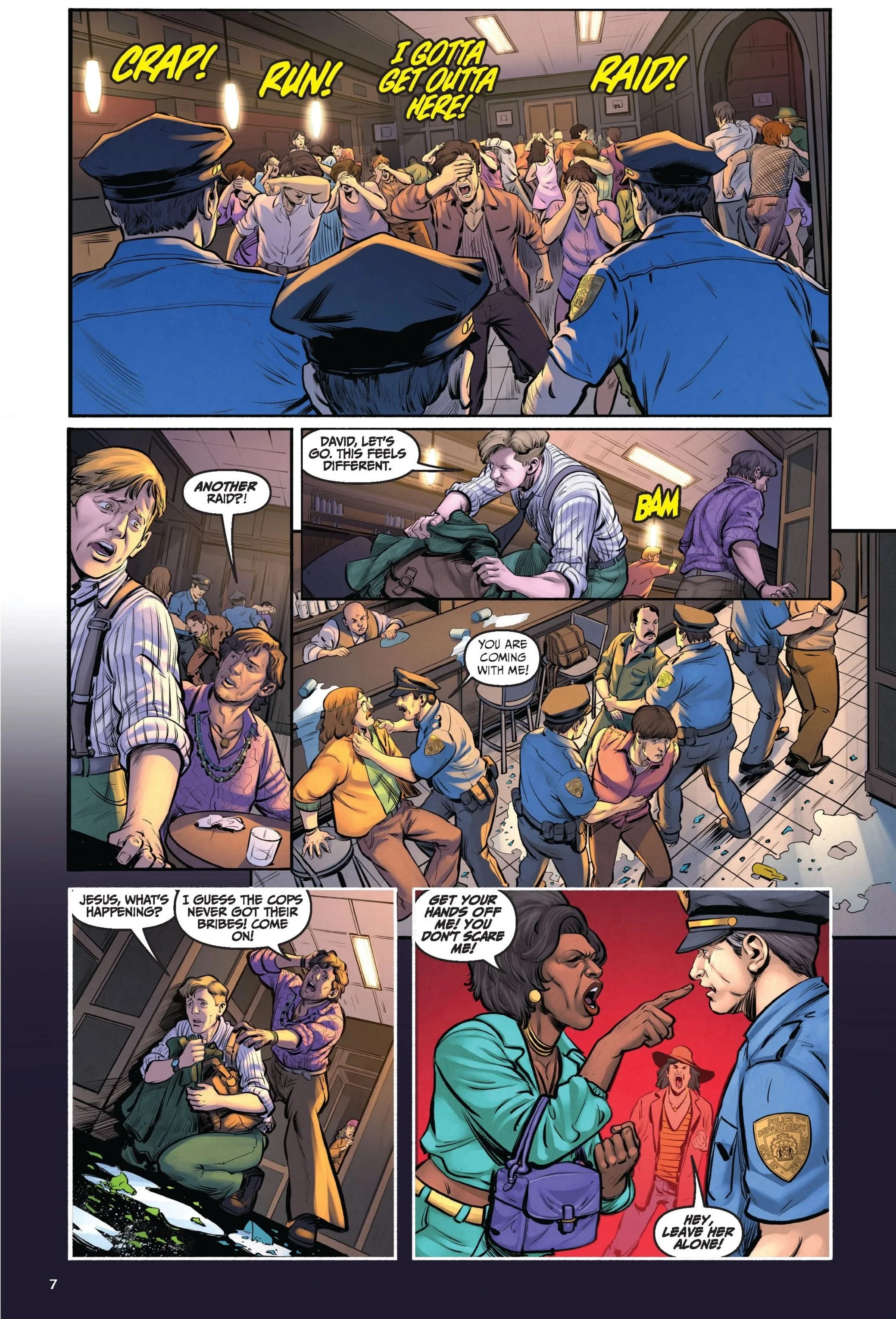
Gay bars like Stonewall were symbols of the LGBTQ+ community and were important for allowing LGBTQ+ people to reclaim their agency; they could go to the gay bar and not hide who they were.
In panel 1, we see the police raiding the Stonewall Inn. The policemen are used as framing elements, meaning that they visually frame the attendees at the bar, to show that the attendees are surrounded by the police encroaching on this safe place of community. Many of the patrons are running away and hiding their faces. This shows that the people there were not expecting a police confrontation; they had not organized for a formal or planned protest and were just going about their business. They were attendees, not necessarily activists.
Many of them were closeted people who did not want to be exposed as members of the LGBTQ+ community because it could cost them their jobs or families, hence they cover their faces and run away. This theme is further built as we see Arnie quickly gathering his things and fleeing the scene in panels 2 and 3 as he exclaims to David that they need to run away, and panels 4 and 5 show the general panic and chaos of the moment. These panels use tilted horizon lines, giving the viewer an unbalanced feeling that reflects the high emotions in the scene—the characters are panicked and unsteady and unprepared, and the camera angle emphasizes that, becoming more and more extreme until it culminates in the Dutch angle in panel 5.
Panels 3 and 4 also guide the eye into a sort of funnel leading off the page (follow the angle of the room from Arnie to David in panel 3, and the angle of the people from bottom left to top right in panel 4), showing that in the chaos, people are being shunted away by the police to be literally removed from the narrative, reflecting the erasure that the police sought to impose on the LGBTQ+ community.
In panel 3, Arnie says to David that this raid “feels different”—picking up on the fact that Stonewall was different from previous demonstrations. While people getting arrested as in panel 4 was not necessarily unusual, in panel 6, we see a Black trans woman standing up to the police. The vivid red background communicates the emotional intensity of the moment, showing the frustration of the LGBTQ+ community finally boiling over. For many, Stonewall was a breaking point and they decided to stay behind to fight back against discrimination by the police and society as a whole.
Many of those who stayed to fight were marginalized queer people, such as young, unhoused, or people of color. This theme is especially emphasized in panel 3, where Arnie urges David, a man of color who has already lost his job because of prejudice, to leave with him, but David’s back is turned, indicating he is not on the same page about leaving as Arnie, which we will see later in the story. As the spontaneous protest went on, we see in panel 6 that bystanders like the man in the background also got involved to support the patrons of the bar.
Why Comics Are a Powerful Way to Teach History
Kate Polak’s book, Ethics in the Gutter, speaks about historiometagraphic fiction, which “is meant to encapsulate works that deal with real-world events in fictional ways so as to comment on the way in which we shape narratives, receive them, and reframe them.” Two vital concepts to think about when analyzing historiometagraphic fiction like Arnie’s Byline are point of view as entry and comics as avenues to ask ethical questions.
In contrast to traditional prose, where students learn to identify the difference between first, second, and third person, comics have a unique ability to highlight different points of view in different panels based on camera angle and choice of subject. As mentioned before, panel 1 shows police encroaching on the safe space, but it also places the viewer behind the police so that we are seeing their point of view—people hiding their faces and running. Generally, when placed behind a character to see what they are seeing, that helps readers identify with that character.
The other way that readers connect to characters is by seeing their faces—the following panels have increasingly extreme horizon lines and focus on the body language and facial expressions of Arnie and David, emphasizing their point-of-view as things become more panicked and chaotic. Because the visual representations of an event can often be more striking to viewers than simply reading about an event, any ethical questions posed by the comic can be more impactful.
“The term historio-metagraphics is meant to encapsulate works that deal with real-world events in fictional ways so as to comment on the way in which we shape narratives, receive them, and reframe them.” Kate Polak, Ethics in the Gutter: Empathy and Historical Fiction in Comics (Studies in Comics and Cartoons)
In Conclusion
Comic books can bring history to life in the classroom in ways that traditional textbooks and curriculums cannot, providing deeper opportunities for students to connect with the events and people of the past and take lessons from them that they can use to impact their present. Order copies of Arnie’s Byline for your classroom, sign up for our professional development webinars, and shop more of our inclusive catalog.
To hear all our latest updates, including new books, blog posts, and professional development opportunities, join our mailing list.
