
Gaspar's Home: The Great Dismal Swamp Teaching Tips
August 5, 2026 | 18 min read
Teaching the Great Dismal Swamp with Comics
Quick Tips on Using Comics for Educators
Written by TrueFiktion Staff
The Great Dismal Swamp is a large swamp located in Virginia and North Carolina that played an important role in the history of slavery and marronage, but is not often well-covered in traditional history curricula. Our book, Gaspar's Home, seeks to help fill that gap through the story of Gaspar, a long-time maroon who must save his son from slavecatchers trying to encroach on the Swamp. This blog post is a companion to Gaspar's Home, designed to give you a quick deep-dive on the Great Dismal Swamp, a list of solid primary sources, and guidance on how to use our comic book to teach in your classroom.
What Happened at the Great Dismal Swamp?
The Great Dismal Swamp, spanning parts of Virginia and North Carolina, was a vast, inhospitable wilderness that became a refuge for enslaved people seeking freedom from the 17th to the 19th centuries. Known for its dense vegetation and treacherous terrain, it was home to maroon communities—self-liberated individuals who established hidden settlements and resisted recapture.
These communities often lived in secrecy, relying on their knowledge of the swamp’s resources and sometimes forming networks with Indigenous peoples or abolitionists. The Great Dismal Swamp stands as a symbol of resilience and resistance, highlighting the lengths enslaved people went to seek autonomy and freedom.
What Was It Like in the Great Dismal Swamp?
The Great Dismal Swamp illustrates how geography can serve as a refuge for resistance, as its dense wetlands provided an inaccessible haven for enslaved people escaping bondage and indigenous groups avoiding colonization. Its challenging terrain enabled the creation of hidden, self-sustaining maroon communities, showcasing how the natural environment can empower marginalized groups to defy systems of injustice.
The Great Dismal Swamp was originally inhabited by Indigenous peoples, who used it for hunting, fishing, and refuge, but over time it became a haven for self-liberated enslaved individuals, transforming into a diverse sanctuary of resistance. Those who lived in the peripheral regions presented more resistance to the institution of slavery because of their increased contact with the ‘outside world’. Among its inhabitants were African-born maroons, acculturated enslaved people with varying skills and trades, and even some who worked within the swamp’s timber and canal industries while secretly building lives of autonomy in its depths.
The diversity reflects a complex social dynamic that goes beyond mere survival, yet this diversity is often underexplored in studies of marronage. Understanding how these groups interacted, adapted, and thrived together exposes a significant gap in the research, offering potential insights into the nuanced ways maroon communities resisted and redefined systems of oppression.
Maroons in the Great Dismal Swamp not only survived in exile but established thriving, multi-generational communities, cultivating food, constructing shelters, and creating social and cultural networks within the swamp’s isolation. These communities demonstrated resilience and ingenuity, blending diverse traditions and knowledge to maintain a sense of autonomy and continuity across generations despite the constant threat of discovery and recapture.
How Does the Great Dismal Swamp Teach Us About the Resilience of the Maroon Community?
Maroons in the Great Dismal Swamp demonstrated resilience by creating self-sufficient communities, relying on their knowledge of the land to hunt, farm, and build shelter, thereby asserting their independence in the antebellum South. They adapted to the harsh environment, using its natural barriers for protection while developing social structures and networks that sustained their independence over decades. Their refusal to remain passive in the face of enslavement, coupled with organized acts of resistance like uprisings and sabotage, marked their active defiance against a system designed to strip them of their freedom.
By escaping to the Great Dismal Swamp, maroons seized their freedom and rejected the brutal confines of slave culture, choosing autonomy over oppression. In claiming the swamp’s isolation as their own, they became masters of their destinies, building lives defined by self-determination and resilience despite the surrounding system of enslavement.
Maroons in the Great Dismal Swamp actively resisted the dominant slave culture by organizing rebellions and uprisings in nearby communities, posing a direct threat to the institution of slavery itself that slaveholders greatly feared. The very act of "stealing oneself" and escaping into the swamp was a profound act of rebellion, asserting autonomy and rejecting the control of enslavers while inspiring resistance in others.
Why Is the Great Dismal Swamp Relevant Today?
Archaeology plays a crucial role in uncovering the lives of maroons in the Great Dismal Swamp, providing physical evidence of their resilience and self-sufficiency in the absence of written records. By analyzing artifacts such as tools, pottery, and remnants of settlements, modern researchers can piece together the stories of these communities, ensuring their struggles and achievements are not forgotten in the broader narrative of history.
Archaeological efforts in the Great Dismal Swamp uncover the voices and agency of marginalized groups whose stories are often omitted from traditional accounts of slavery. By examining material culture and settlement patterns, these studies offer a richer, more inclusive understanding of history, highlighting resistance, self-determination, and the creation of autonomous communities outside of the dominant narratives of oppression.
Studying marronage in the Great Dismal Swamp challenges Eurocentric narratives by highlighting the agency, resilience, and resistance of enslaved individuals rather than focusing solely on their victimization. It reframes the history of slavery in America to include stories of self-liberation and community-building, emphasizing the active role enslaved people played in shaping their own destinies and defying oppressive systems.
Primary Source: Excerpts from Narrative of the Life of Moses Grandy; Late a Slave in the United States of America.
What it is: An excerpt from the autobiography of Moses Grandy, who was a formerly enslaved person who through many struggles and attempts to purchase his freedom, finally succeeded. This excerpt specifically talks about his time in the Great Dismal Swamp after Captain Minner, a white abolitionist, helped him buy his freedom from his slaveholder, who had frequently cheated Grandy in the past. Grandy wants to repay Captain Minner the money and does so by working the canal boats in the Swamp.
Why we like it: There are not many written accounts about life in the Great Dismal Swamp, but this is a firsthand account of life in the Great Dismal Swamp, and also gives an account of how people escaped slavery and what the cultural attitude towards slavery was and how it was shifting, from the point of view of a formerly enslaved person.
How to use it: Students can focus on several aspects of the excerpt. Firstly, the passage shows the natural dangers of living in the Great Dismal Swamp—“severe weather,” animals—and also shows the fear and anxiety that even someone who legally escaped slavery like Grandy faced. Grandy worries that despite having done everything “right,” he could still be recaptured and re-enslaved. Though the Swamp presented challenges, staying there also protected Grandy from the worse evil of being re-enslaved.
Secondly, Grandy’s description of the difficulties of fleeing slavery is worth study. Students can look at literary devices he uses to paint a more vivid picture, such as parallelism, simile, and imagery, and study how that makes them feel. Additionally, his description gives insight into the current state of public opinion—he identifies Quakers as definite abolitionists, and also notes that the number of people who are against slavery is increasing in 1844 when he records his story.
What Are Experts Saying?
Joshua Strayhorn, Ph.D., is an award-winning Mellon Humanities Postdoctoral Fellow at the National Park Service and author of the forthcoming Freedom's Promise: Black Mobility and Migration in North Carolina, 1861 -1898. He focuses on expanding access to education about marginalized groups.
What is the most misunderstood or unknown thing about the Great Dismal Swamp?
Many people don’t realize how prevalent maroon communities were–historians estimate that there were thousands of maroons in the Great Dismal Swamp alone. Usually, Jamaican, Brazilian, and other maroon communities in South America and the Caribbean get more attention than the maroon communities in what would become the United States. This is partly because of the scale of Caribbean and South American marronage, but also because U.S. marronage received far less attention in the historiography.
Maroon communities are also incredibly diverse--maroons in Jamaica established extensive communities and negotiated their power with British officials, even agreeing to capture enslaved people on behalf of the British in exchange for freedom. The network was a bit more expansive than it was in the U.S. because of the sheer numbers and density of enslaved people in South America and the Caribbean. Jamaica had considerably more slaves than North Carolina, which had fewer enslaved people compared to some other Deep South states.
However, the U.S. had several maroon communities with their own economies, raiding practices, and armed resistance. Though the maroons experienced a semblance of freedom, it was always unstable and tenuous because they could be recaptured at any moment.
What are the most relevant effects of the Great Dismal Swamp today?
It’s important to think about preservation and what it means to have a space like the Great Dismal Swamp as an ecological wonder. It is a great natural resource for us and a very unique environment that deserves respect and protection from human threats like logging and drainage. There is a wildlife refuge and a North Carolina State park there today, but there are now efforts to make it a National Heritage Area.
We often focus on the environmental aspects of the swamp today because of the Great Dismal Swamp, but we often don't talk about the ways in which people move through and around that space, and whose story gets to be told about that space. How can we use the history of marronage in the Great Dismal Swamp to inspire additional explorations into maroon activity across the U.S? In the National Park Service alone, there are numerous sites of maroon activity in the swamps and mountains that NPS stewards. So, if it becomes a National Heritage Area, what sort of programming would we do around maroons there? Will freedom-seeking become a memorialized part of its history?
Maroon communities, in general, are important to study, and I think it is a great opportunity to explore both fascinating history and preserve our relationship with the land.
How to Read a Comic Page
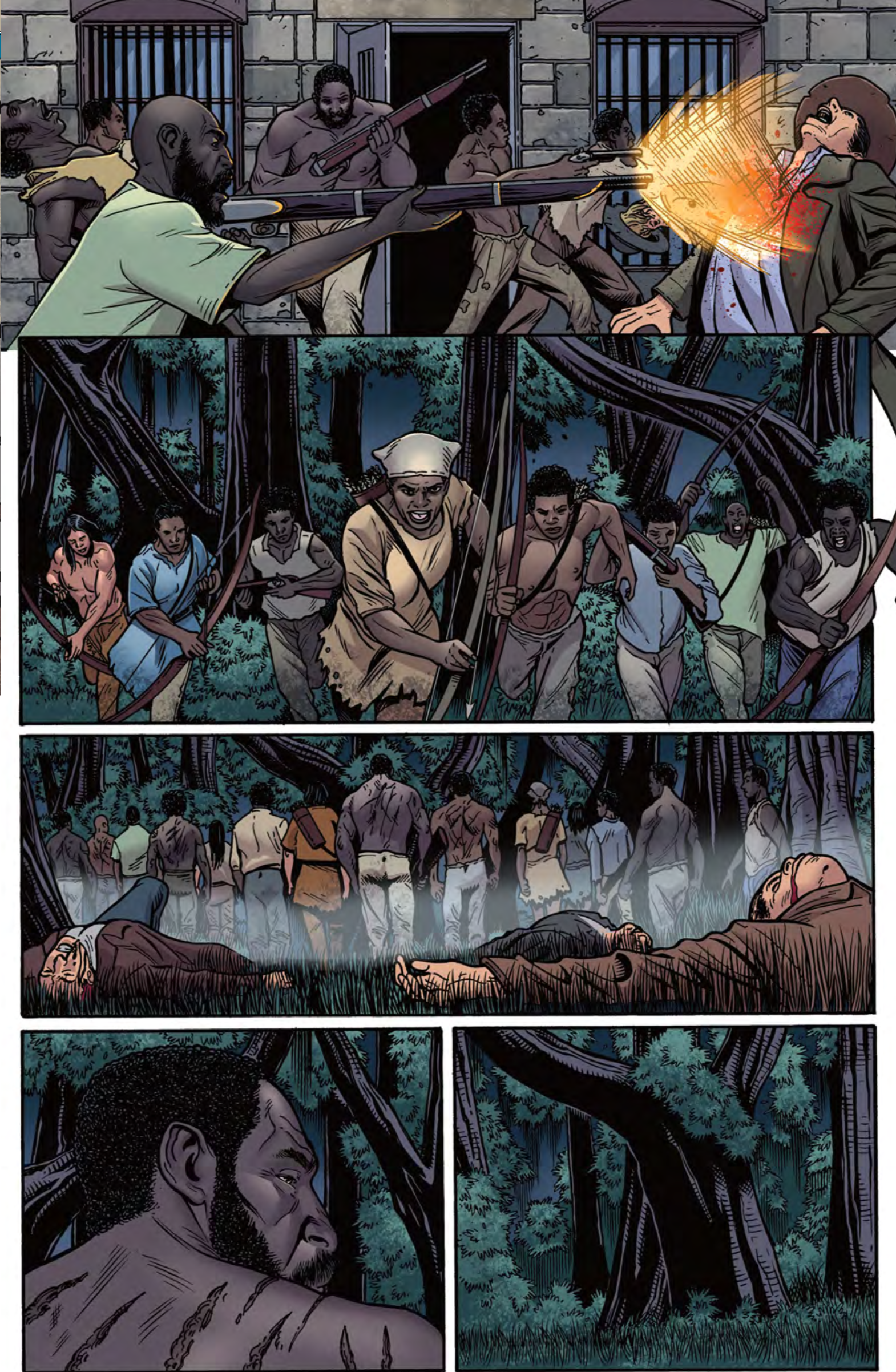
The first panel shows the maroons escaping the prison using the weapons that Gaspar has captured and brought for them, and the second shows more maroons coming from the Swamp to aid their community members. The panels are action-packed and dynamic, emphasizing the maroons’ active defiance and resistance to the institution of slavery. The art shows Black and Native maroons of multiple generations to show the diversity of the Great Dismal Swamp maroons, and they are also carrying weapons that they have made, such as bows and arrows, that show their self-sufficiency and extensive cultural knowledge. The communities in the Great Dismal Swamp were thriving and strong.
Panel 3 shows the reunited maroons walking back into the Swamp together. Gaspar and Ezekiel walk side-by-side, Gaspar with his old scars and Ezekiel with his new ones, showing again the multi-generational nature of the maroon communities, but also the intergenerational trauma and ongoing threat that the institution of slavery posed to Black families, even free maroons.
Meanwhile, the dead slave catchers are used as framing elements for the panel—framing elements are typically foregrounded parts of a panel that form a frame around the focus of the panel. Using the dead slave catchers in this way shows the threat they posed to the maroons, visually hemming them in, but also shows the power of the maroons’ resistance. The dead slave catchers show that marronage was a direct threat to the institution of slavery itself and challenged Eurocentric narratives that seek to erase them from history.
Panel 4 shows Gaspar looking over his shoulder. His scars from when he was enslaved are visible on his back, and his expression is nuanced. Gaspar is the hero of the story, emphasizing self-liberation and dedication to his community. Panel 5 is similar to panel 4, except it shows only the Swamp, implying that the maroons have once again vanished into its depths, away from slave catchers and others who might harm them. It emphasizes the geography of the Great Dismal Swamp and how it helped the maroons to escape oppression and protected them.
Why Comics Are a Powerful Way to Teach History
Kate Polak’s book, Ethics in the Gutter, speaks about historiometagraphic fiction, which “is meant to encapsulate works that deal with real-world events in fictional ways so as to comment on the way in which we shape narratives, receive them, and reframe them.” Two vital concepts to think about when analyzing historiometagraphic fiction like Gaspar's Home are point of view as entry and comics as avenues to ask ethical questions.
In contrast to traditional prose, where students learn to identify the difference between first, second, and third person, comics have a unique ability to highlight different points of view in different panels based on camera angle and choice of subject. As mentioned before, panel 4 is a close-up on Gaspar with a somewhat difficult-to-read expression. The contrast between the first three panels being zoomed-out and showing many characters to suddenly jumping to a close-up on a single character is a storytelling technique that makes the close-up stand out more and gives it more importance.
Typically, close-up shots on characters are meant to help readers identify with the character’s emotions, usually focused on the character’s expression. This panel is interesting because Gaspar has his back turned, showing his scars, and his expression is intentionally nuanced and difficult to read, and it is also a fourth wall break, where Gaspar seems to set his eyes on us, the readers.
The last panel leaves the reader outside the Swamp entirely, simply watching the maroons disappear. This artistic choice makes sense for the characters and story, since they are returning to their safe and hidden community, but it also reflects our point of view as modern readers who do not have complete access to the history of the Great Dismal Swamp due to lack of written records.
While the ending likely leaves readers wanting to see more of how Gaspar and Ezekiel’s lives continue, it is also a display of the characters’ agency to disappear even from the reader’s view. Because the visual representations of an event can often be more striking to viewers than simply reading about an event, ethical questions posed by the comic can be more impactful.
“The term historio-metagraphics is meant to encapsulate works that deal with real-world events in fictional ways so as to comment on the way in which we shape narratives, receive them, and reframe them.” Kate Polak, Ethics in the Gutter: Empathy and Historical Fiction in Comics (Studies in Comics and Cartoons)
In Conclusion
Comic books can bring history to life in the classroom in ways that traditional textbooks and curricula cannot, providing deeper opportunities for students to connect with the events and people of the past and take lessons from them that they can use to impact their present. Order copies of Gaspar's Home for your classroom, sign up for our professional development webinars, and shop more of our inclusive catalog.
To hear all our latest updates, including new books, blog posts, and professional development opportunities, join our mailing list.
