
Joe's Last Stand: The Battle of Blair Mountain Teaching Tips
September 10, 2026 | 18 min read
Teaching the Battle of Blair Mountain with Comics
Quick Tips on Using Comics for Educators
Written by TrueFiktion Staff
The Battle of Blair Mountain is one of the most famous uprisings for workers’ rights in American history, but is not often well-covered in traditional history curricula. Our book, Joe's Last Stand, seeks to help fill that gap through the story of Joe, a young white coal miner who stands up to his oppressive company for his rights. This blog post is a companion to Joe's Last Stand, designed to give you a quick deep-dive on the Battle of Blair Mountain, an additional primary source for classroom use, and guidance on how to use our comic book to teach in your classroom.
What Happened at the Battle of Blair Mountain?
The Battle of Blair Mountain (1921) was the largest labor uprising in U.S. history, where 8,000–15,000 coal miners clashed with private security, local law enforcement, and eventually federal troops in Logan County, West Virginia. The Battle was one of the first armed uprisings of laborers, but existed within a longstanding series of issues between coal miners and mine companies.
The miners were fighting for the right to unionize, better working conditions, and to free imprisoned miners. But they were met with heavy resistance from local law enforcement and federal troops who even resorted to using aerial bombings against their fellow citizens (and often, fellow veterans). The battle ended when federal troops arrived, forcing the miners to surrender, but it marked a key moment in the labor movement despite the miners' defeat.
What Are the Historical Contexts Around the Battle of Blair Mountain?
Early industrialism and the exploitation of workers are crucial to the Battle of Blair Mountain because they reveal the systemic inequalities that fueled the miners' revolt, such as low wages paid in company ‘scrip’ (money that was only usable within the company shop), dangerous working conditions, and unregulated labor practices designed to maximize profit at the expense of human life. This context highlights how industrial growth concentrated wealth and power in the hands of coal operators while disenfranchising workers, making the battle a key moment in the broader struggle against capitalist exploitation.
The process of unionization posed a significant threat to company control of mine workers by empowering them to collectively bargain for better wages, working conditions, and rights, thereby challenging the exploitative practices of coal operators.
During the Battle of Blair Mountain, thousands of armed coal miners, many affiliated with the United Mine Workers of America (UMWA), clashed with private security forces and federal troops in one of the largest labor uprisings in U.S. history. This dynamic underscores the broader implications of labor organization in dismantling the oppressive structures of industrial capitalism and asserting workers' rights, as the miners’ struggle highlighted the extreme measures coal companies would take—including hiring armed guards and influencing government intervention—to suppress union efforts.
How Does the Battle of Blair Mountain Teach Us About the Resilience of the Working Class Community?
The Battle of Blair Mountain saw organized miners, led by former World War I veterans, utilizing their military experience to combat a militarized response to the mining company, which included the use of local police, private security forces, and aerial bombardment. They used military tactics like flanking maneuvers and trench warfare against a heavily fortified force of local law enforcement, private detectives, and anti-union militias.
The coal companies' forces entrenched themselves on Blair Mountain, a strategic geographic location that stood in the way of the miners' advance to Mingo County, where several miners were being held prisoner, highlighting the significance of geography in the conflict.
Cross-racial group unity played a vital role in the resiliency of the strikers during the Battle of Blair Mountain, as miners from diverse backgrounds came together to confront their common struggles against exploitation and violence. 20% of the workforce was Black, and 35% were immigrants, meaning cross-social unity was essential to cooperation and unionization. Miners often defied company orders to remain segregated in cafeterias and food halls; keeping workers from different social and racial groups separated was a tactic used by the mine companies to prevent unionization.
This solidarity not only strengthened their collective resolve but also challenged the divisive tactics employed by coal operators, demonstrating that shared goals could transcend racial and social boundaries in the fight for workers' rights.
The strikers at Blair Mountain were able to organize against the violence by forming a unified front that transcended social and racial divides, bringing together white, Black, and immigrant miners under a common cause of labor rights. Despite the company’s efforts to divide them, the miners used solidarity, shared grievances, and collective action to build a stronger, more diverse force capable of challenging the company's army and private security.
Why Is the Battle of Blair Mountain Relevant Today?
The Battle of Blair Mountain remains relevant today as it serves as a powerful reminder of the lengths to which workers have historically gone to secure their rights to unionization and collective bargaining in the face of oppression. Its legacy informs current labor struggles by illustrating the importance of solidarity among workers and the ongoing fight against systemic exploitation in various industries, emphasizing that the quest for fair treatment and equitable working conditions continues to be a vital issue.
The Battle of Blair Mountain also exemplifies the ongoing struggle for fair and safe employment, emphasizing that the rights and protections workers seek should be universally guaranteed, regardless of their background. This historical conflict serves as a powerful reminder that achieving workplace safety and equitable treatment requires collective action and solidarity among all workers, reinforcing the notion that no one should endure exploitation in pursuit of their livelihoods.
Primary Source: Page 2 of The Washington Times from September 1, 1921
What it is: It is the second page from the September 1, 1921 issue of The Washington Times, containing several articles covering Blair Mountain.
Why we like it: Firstly, the newspaper shows what big news the Battle of Blair Mountain was at the time, making the main headline on the front page and taking up most of the second page. The second page contains two articles pertaining to Blair Mountain—“13 Planes Will Bomb Marchers” and “Logan County Bristles with Machine Guns.” The first is more informative and tries to take a more neutral stance, while the second is slightly more opinionated, showing the point of view of the Logan defenders rather than the miners.
How to use it: Students can analyze the first article, “13 Planes Will Bomb Marchers,” to get an idea of the movements of the miners and Chafin’s men, and the more technical aspects of what equipment and tactics are being used by either side, including machine guns and planes, as well as sniping tactics and woman spies.
It also gives some idea of how information flowed around at the time, since the article is careful to specify its sources and what is verified and what is not (because Chafin “refused to talk” and imposed censorship), and tries not to use much emotionally charged language.
The second article can be compared to the first article, since it uses much more emotionally charged language even in its title, and attempts to capture more of the feeling of the moment from the point of view of the Logan defenders. Students can also take note that, perhaps in the context of Chafin’s censorship, the more biased article is biased against the miners, reflecting general societal attitudes about the conflict.
What Are Experts Saying?
Bob Hutton is an associate professor of History and Appalachian Studies at Glenville State University. He received his doctorate from Vanderbilt University in 2009 after studying history at Appalachian State University in NC and George Mason University in VA. His current project, tentatively titled Dixie’s Detectives: The Baldwin-Felts Agency and the Building of Appalachian Capitalism, is supported by the Jonathan G. Utley History Support Fund and the Mining History Association.
Why is the Battle of Blair Mountain an important historical moment to study?
There's a sense of class frustration and class consciousness in America today that was not as noticable in the late 20th century. The very concept of the Battle of Blair Mountain has a certain resonance to people. Although it wasn't a complete success, it is a story of workers rising up that not many people know about. Even my students here in West Virginia didn't necessarily grow up hearing about it. Outside of the small local area where it happened, the story hasn't been highlighted.
Why was Blair Mountain forgotten so quickly?
It challenged a lot of preconceptions Americans have about their own country. We live in what's allegedly a democracy, and the very idea of class consciousness or class conflict is supposed to be anathema to people who all pay homage to the same flag.
Watching the creation of the Soviet Union, American leaders genuinely feared class consciousness because it challenged the idea that you can have democracy and also have this gross amount of economic inequality, and it challenged the idea that people should be satisfied with only the right to vote. Blair Mountain happened less than a year after women got the vote for the first time in the United States.
There's so much going on in a short period, and for Blair Mountain to happen in such a sparsely populated state that was considered out of the way even in 1921 caught America by surprise. No one was sure how to contextualize it, except those who identified it as class conflict.
The powers that be denied it and said, "Well, it's just those unruly hillbillies." They used pre-existing stereotypes of the "mountain white" as naturally aggressive, violent, and ignorant, to distort the event or shove the story under the rug entirely. Historians in recent years have pushed against that and emphasized its importance.
Where does Blair Mountain fit into the larger context of labor disputes in America?
It fits well into the context of that long Red Summer that began during World War I when Americans are asking, what does democracy really mean if I can't feed my family? What does democracy really mean if in one generation, I've gone from owning my own means of production to being a wage earner?
It has immense modern relevance. It's proof that class exists in a country that has always tried to deny the existence of class, in a country where we tell ourselves that everyone's free, and therefore the fact that some have a little bit more freedom in the bank shouldn't matter. The phrase "American Dream" was popularized during the Great Depression-- the general understanding that everyone should own their own home and car. It's not something that people in the era of the mine wars considered.
A lot of people at Blair Mountain came from countries where wealth inequality was much more gross, such as Hungary or Serbia. A lot of them wanted to assert themselves as new Americans. Why does the United States seem so much like Czarist Russia? In the 21st century, there's a real sense among young people that we should focus on these moments in history to demonstrate that inequality has always been a reality.
Shaun Slifer is a community-taught artist and history nerd. He worked with Justseeds, a leftist graphics distro, on a poster series called “Celebrate People's History,” focused on history that is often excluded from traditional curriculum. He is an exhibit tech at the West Virginia Mine Wars Museum and was involved in the anti-mountaintop removal movement. He is interested in the link between organized labor and ecological concerns, and in museums as storytelling modes.
What role did the hillbilly stereotype play in the media following the Battle?
We still have those stereotypes today. It has to do with ‘othering’ populations that are rural – city folk are often suspicious of populations that appear isolated from large urban areas. In the Battle itself, there were two irregular armies. The fighters didn’t have all the same weapons or uniforms. People showed up in whatever they had. In some cases, they came in their WWI uniforms because they had been in the service, but others showed up in overalls.
So in order to signal who was on which side, the unionist miners wore red bandanas around their necks, and the defensive force wore white armbands. The term “redneck” has several different points in history and geographically where it crystallizes, but in Appalachia, and in many ways the larger US, the term “redneck” crystallized at that time to paint the Unionist minors as an uncontrollable mob. It was a multi-racial, multi-ethnic mob.
Calling them “rednecks” was to put them in a box and denigrate them. The way we experience the term now comes from back then, to a degree. In the current resurgence of organized labor interests, we see a lot of red bandanas at protests around the US. The hillbilly archetype itself stretches back further than that and then stretches ahead into popular TV shows in the 1970s and 80s. They were painted as people who have not evolved in pace with modern society and were therefore lesser people.
With the mine wars, there was a lot of mainstream media propaganda at the time that built off of hillbilly archetypes. Stereotypes about mountain people being backward had already begun to crystallize, and these negative stereotypes affected the way the story was reported in newspapers. Some of the work today is dismantling those stereotypes.
For roughly 20 years, people in the coal fields in West Virginia were attempting to redress their grievances through any means that they possibly could. It wasn't originally the plan to pick up rifles. Conditions just became so bad that they did. The coal fields at that time, 100 years ago, were extremely demographically diverse in a way that West Virginia is not today. So when we talk about the private security forces who were in the militias making it difficult to unionize, a lot of it had to do with racism and anti-immigrant sentiment.
It's pretty easy now to think about West Virginia as primarily white people in dispersed rural settings, but 100 years ago, it wasn't that way. There are a lot of questions about what solidarity looked like at that point.
What are some important historical themes or contexts for understanding the Battle of Blair Mountain?
Solidarity is a big one. People came together across racial and ethnic lines for the common good. It was about a type of collectivism, not individualism. In my opinion, regardless of your political education as an individual, when they're in community with others people tend to lean towards what we would call “the left.”
There was some influence in the movement from the Socialist Party earlier on – some of these labor leaders were reading Marx. We see in the movement a lot of what we would define as communalism and cooperation, but in ways that are not politicized as such. At the Mine Wars Museum, we tell the stories as they are, and it's interesting to see how people reach a common understanding when you remove the politicized rhetoric from the story.
It’s also tricky to define what solidarity actually is. Did people think of it as solidarity at the time, or did they simply think “we should all be lifting each other up”? It points to the lack of politicized language in the movement, so some historians hesitate to politicize it.
Personally, I think of solidarity as putting as much of my life and privilege and whatever else I can on the line in order to help somebody else. In that case, I think running up the side of a mountain ridge with a rifle next to whoever's running with you is solidarity. In the longer arc of Black migration into Central Appalachia to mine coal, once mechanization started to come into the underground mines, racism then started to determine who got the better jobs, and many people continued to move up north into industrial cities like Detroit or Chicago.
So solidarity was perhaps not something that stayed as deeply entwined in the fabric of the region, but for that moment, it was important. One of the stories that everybody likes in this one town, Clothier, where miners marched through coming down from outside of Charleston. Their ranks were building, and they came across a segregated cafeteria and forced it to desegregate. It's great that they did that and I believe that they should have, but I still think solidarity is complicated..
Chuck Keeney is a history professor from West Virginia and one of the founders of the West Virginia Mine Wars Museum. He was president of a group called Friends of Blair Mountain that successfully fought to protect the Blair Mountain battlefield from two coal companies, the US National Guard, the state government of West Virginia, and the second largest landowning corporation in America. He has written extensively on the mine wars, including his book The Road to Blair Mountain (2021). He also started the museum’s journal and has appeared in documentaries about Blair Mountain, Appalachia, and coal and its impacts.
What role did the topography play in the Battle of Blair Mountain?
North of the town of Logan itself, there is a series of ridge lines, almost like a wall. It’s a continuous ridge stretching for about 12 miles, and it's really, really steep, almost like a walled fortress. The company men set up a defensive position there to prevent the miners from progressing further south, and they had machine gun emplacements all along. They used a lot of local espionage to figure out where the machine gun emplacements were, and they made a plan to attack the northern and the southern flanks.
The southern flank was the Battle of Blair Mountain, fought on a 12-mile front. Blair Mountain was the southernmost portion of the battlefield because they were trying to outflank both sides by hitting the north and the south in two different groups. The miners almost made a breakthrough at Crooked Creek gap, but couldn’t. They fought for four days. On the fifth day, the US Army showed up and the miners surrendered.
How to Read a Comic Page
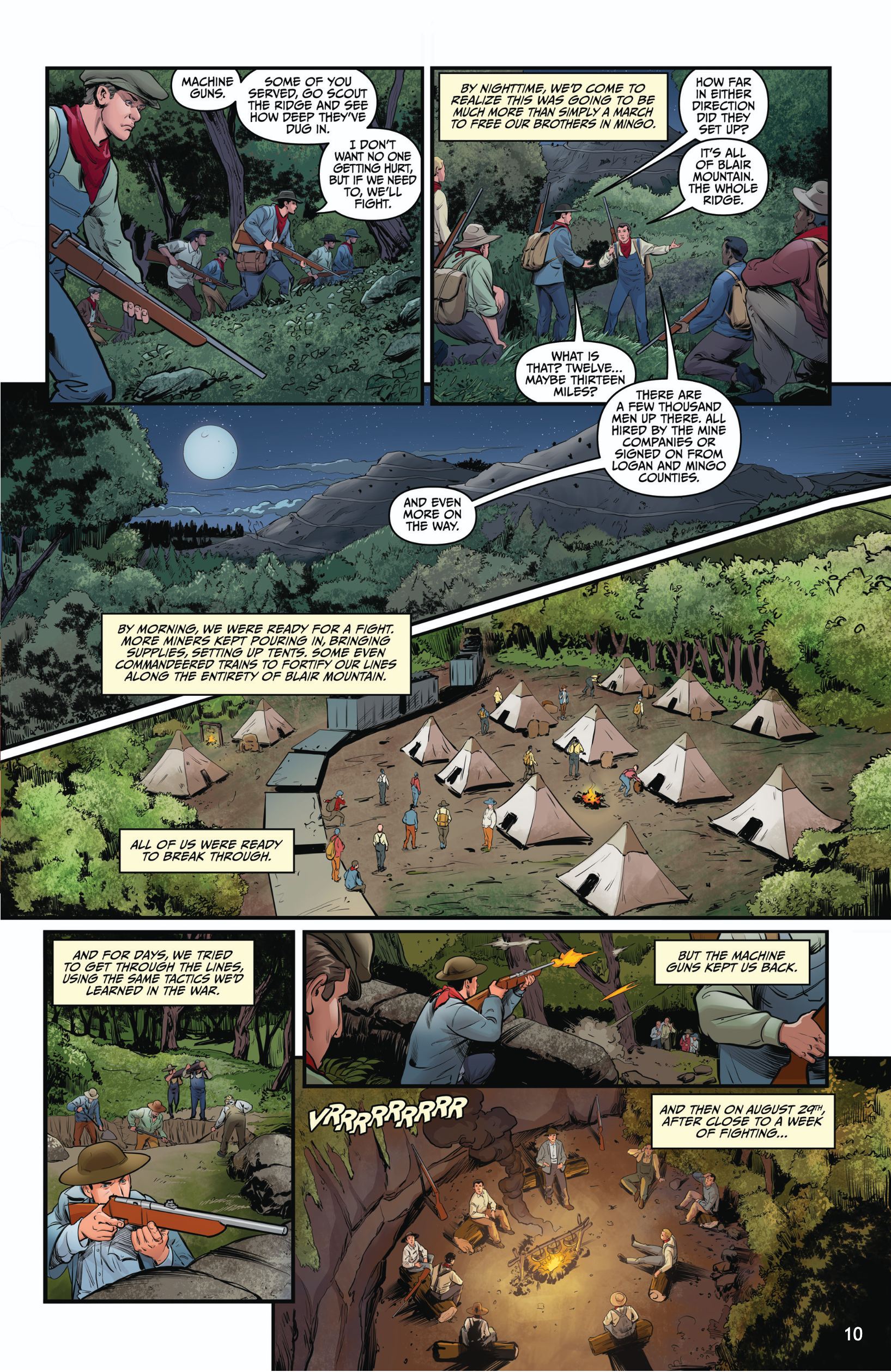
This page shows several important themes. The Battle of Blair Mountain was a very organized resistance led by WWI veterans like Joe—he wears the same hat he wore during his military service, and in panels 1 and 5, he mentions how their military training is assisting them in resisting the mine companies and their allies.
Despite everyone wearing different outfits, showing that the miners simply came with whatever they had, the neat array of the tents in panel 4 also shows the theme of organization, and the miners’ use of trains to fortify their position is a nod to the early industrialism going on at the time—though that same industrialism and worker exploitation was the root of their problems, they were able to use what was available to them to their advantage. Also visible in the character designs is the theme of cross-racial unity and solidarity.
One of the most notable aspects of this page is the focus on topography of Blair Mountain. The first row of panels has a general upward slant in the art as the characters literally march uphill, and the way that panels 3 and 4 are divided with a slanted line further emphasizes this angle. It is a way of visually communicating the uphill battle that the miners were facing in resisting the mining companies.
Also important in emphasizing the topography is the use of foreground, midground, and background elements—for example, in panel 1, the large miner in the front is in the foreground, Joe and the other miners are in the midground, and the trees behind them are in the background. This page makes repeated use of panels with lots of depth to them in order to emphasize the thick, lush forest environment of Blair Mountain that necessarily played a role in the battle tactics.
Another important note is the red handkerchiefs that the miners wear. An emblem of their unionization efforts and later a lasting symbol of labor struggles that continues to resonate with people today, the red handkerchiefs are an example of using color for emphasis in visual storytelling. For example, every panel where the red handkerchiefs appear, the other elements including characters and backgrounds are generally very cool-toned, which makes the contrasting warm-toned handkerchiefs stand out more.
Why Comics Are a Powerful Way to Teach History
Kate Polak’s book, Ethics in the Gutter, speaks about historiometagraphic fiction, which “is meant to encapsulate works that deal with real-world events in fictional ways so as to comment on the way in which we shape narratives, receive them, and reframe them.” Two vital concepts to think about when analyzing historiometagraphic fiction like Joe's Last Stand are point of view as entry and comics as avenues to ask ethical questions.
In contrast to traditional prose, where students learn to identify the difference between first, second, and third person, comics have a unique ability to highlight different points of view in different panels based on camera angle and choice of subject. As mentioned before, the use of varying depths is very important to the construction of this page, and helps to emphasize the point-of-view by putting the reader directly in the scene.
For example, in panel 2, with the foreground characters on either side, it is easy to imagine that we are seeing things from the point of view of another character behind the camera, helping us to identify with the miners. Panel 6 uses a similar framing strategy to make it feel more like we are in the scene with the characters, and any time the viewer is placed behind a character peering over their shoulder, we are meant to identify with the point-of-view of that character as we are being made to share it. In Panel 6, the framing foreground characters and being placed behind Joe help place the viewer in the scene. Because the visual representations of an event can often be more striking to viewers than simply reading about an event, any ethical questions posed by the comic can be more impactful.
“The term historio-metagraphics is meant to encapsulate works that deal with real-world events in fictional ways so as to comment on the way in which we shape narratives, receive them, and reframe them.” Kate Polak, Ethics in the Gutter: Empathy and Historical Fiction in Comics (Studies in Comics and Cartoons)
In Conclusion
Comic books can bring history to life in the classroom in ways that traditional textbooks and curriculums cannot, providing deeper opportunities for students to connect with the events and people of the past and take lessons from them that they can use to impact their present. Order copies of Joe's Last Stand for your classroom, sign up for our professional development webinars, and shop more of our inclusive catalog.
To hear all our latest updates, including new books, blog posts, and professional development opportunities, join our mailing list.
