
Natsumi's War: Japanese American Incarceration Teaching Tips
September 10, 2026 | 15 min read
Teaching Japanese American Incarceration with Comics
Quick Tips on Using Comics for Educators
Written by TrueFiktion Staff
Japanese American incarceration under Executive Order 9066 is often considered one of the federal government’s greatest mistakes, but traditional history curricula tend to include certain misconceptions about the period. Our book, Natsumi’s War, seeks to help fill that gap through the story of Natsumi and Takashi, two teenage Japanese American siblings who are incarcerated and exert agency over their futures in different ways. This blog post is a companion to Natsumi’s War, designed to give you a quick deep-dive on Japanese American incarceration, a list of solid primary sources, and guidance on how to use our comic book to teach in your classroom.
What Was Japanese American Incarceration?
Following the Japanese attack on Pearl Harbor in 1941, and in direct contradiction to previous reports, President Roosevelt signed Executive Order 9066, which allowed for the mass incarceration of Japanese people in America based on their perceived threat to national security.
In reality, very few Japanese or Japanese American people posed a real threat, but xenophobic racism and wartime hysteria led to over 126,000 arrests, two-thirds of which were of American citizens. Paradoxically, the thousands of Japanese living in Hawaii, where Pearl Harbor is located, were left relatively untouched by the government, with people of Japanese ancestry on the mainland bearing the vast majority of the suspicion and racism.
What Are Common Misconceptions About Japanese American Incarceration?
While the period of Japanese American incarceration during World War II is a relatively well-studied and understood event in history, many misconceptions remain. Firstly, two-thirds of those incarcerated were American citizens. The 108 military zones and exclusion orders created by Executive Order 9066 made no distinction between Japanese aliens and “non-aliens,” meaning that both Japanese immigrants and American-born citizens of Japanese descent were forcibly removed from their homes, leading to the incarceration of over 100,000 individuals solely based on their ancestry.
In contrast, German Americans and Italian Americans were not subject to mass incarceration, as they were not perceived as a racial threat in the same way that Japanese individuals were. This stark difference in treatment highlights how deeply racial prejudice, rather than actual national security concerns, shaped U.S. government policies during World War II.
The second common misconception stems from the commonly used term “internment”—camps operated more in line with concentration camps rather than internment, since confinement was based on ethnicity. These camps were different from the Nazi death and labor camps in Europe, as they were not designed for mass extermination or forced industrial labor.
However, Japanese Americans imprisoned in these camps faced harsh conditions, loss of property, and severe violations of their civil rights. The U.S. government justified this policy as a wartime necessity, but it was later recognized as a grave injustice driven by racial prejudice and fear rather than legitimate military concerns.
Because Japanese persons were relocated and interned with very little notice, many families were forced to sell their family homes, personal belongings, and professional businesses at losses, and this significantly impacted generational wealth patterns for Japanese Americans. It has been estimated that those incarcerated in the camps lost $400 million in property during their imprisonment. In 1948, Congress paid back $38 million in reparations, and in 1988 paid $20,000 to each surviving individual.
How Does Japanese American Incarceration Teach Us About the Resilience of the Japanese American Community?
The resilience of the Japanese American community manifested in two ways—through overt challenges to the legality of EO 9066 and the camps and in the ways the Japanese community strengthened while faced with incarceration. Incarcerated Japanese Americans sought to create a sense of normalcy by forming close-knit communities of support within the camps.
They established newspapers, markets, schools, and even police and fire departments to provide essential services and maintain daily routines. They established high schools and formed sports teams, creating spaces for youth development and collective morale. Cultural preservation also played a key role, with performances and lessons in traditional Japanese arts serving as both a form of resistance and a means of sustaining identity and dignity. These efforts helped sustain morale and a sense of dignity, despite the harsh living conditions and unjust imprisonment.
Organized resistance to internment was found both within and outside the camps. In the later years of the war, the US government instituted the draft within the camps. After issuing “loyalty tests” that asked about a prisoner’s willingness to serve in the US military, the disloyal were separated from the loyal, and the loyal were called up through the draft into the 442nd Regiment. 293 Japanese men refused to submit to the draft while their liberties were infringed by the country they were expected to serve.
Four instances of individual resistance resulted in court cases that reached the Supreme Court, and hundreds were charged with draft evasion. Only one of these lawsuits, Ex parte Endo, was successful—it produced a “unanimous decision declaring that an American citizen could not be held in a concentration camp without specific charges and saying that she could not be prevented from returning to her home in California.”
Why Is Japanese American Incarceration Relevant Today?
The story of Japanese American incarceration asks the question, “how far are democratic societies willing to go to ‘protect’ national security in wartime, even if that means infringing upon the personal rights of its citizens?” Congress had to create a new federal crime to give grounds for imprisonment, and it passed without a single dissenting vote. The questions that the period of Japanese Internment raised regarding the balance of personal liberty as it relates to national security in times of concern are still analyzed today. Namely, in what (if any) circumstances is it acceptable to suppress the rights of minority groups in the name of national security?
Forty-six years after the incarceration of Japanese Americans, the Civil Liberties Act of 1988 was signed by President Reagan, marking a historic milestone in the redress movement and providing a formal apology and $20,000 in reparations to each surviving detainee. This achievement was preceded by a critical step in 1980, when President Carter established the Commission on Wartime Relocation and Internment of Civilians (CWRIC), which in 1983 released its landmark report, Personal Justice Denied, concluding that the incarceration was fueled by "race prejudice, war hysteria, and a failure of political leadership" rather than military necessity.
The report recommended a redress plan that included a presidential apology, public education through a foundation, and individual monetary compensation, ultimately leading to the federal government assuming responsibility for identifying and compensating around 60,000 eligible Japanese American survivors.
Primary Source: Excerpts from the Munson Report
What it is: In October and November of 1941, Special Representative of the State Department Curtis B. Munson, under Roosevelt's orders, carried out an intelligence gathering investigation on the loyalty of Japanese Americans. His report concluded that Japanese Americans are loyal and would pose little threat. He wrote: "There is no Japanese `problem' on the Coast ... There is far more danger from Communists and people of the Bridges type on the Coast than there is from Japanese."
Why we like it: It is a relatively reader-friendly text that breaks down the generations of Japanese Americans into Issei (first-generation), Nisei (second-generation and U.S.-educated), Kibei (second-generation and Japan-educated in some capacity), and Sansei (third generation). It shows a broad overview of the opinions of the Japanese American population at the time, of course keeping in mind that the survey was conducted and reported by a white man.
How to use it: Students can focus on two major aspects of the report. Firstly, the contrast between the findings of the report and the actions of the federal government—despite the report saying that there is very little to no risk posed by the Japanese Americans of any generation, Executive Order 9066 was still passed due to wartime hysteria and racist discrimination. Secondly, the report discusses the general attitudes of each generation of Japanese Americans and students can compare and contrast between generations to help understand the community as a whole at the time, and also why different people who were incarcerated had different feelings and different responses to mistreatment. Students can also draw parallels to different communities today who may also have complicated relationships with Americanness.
What Are Experts Saying?
Susan H. Kamei is an award-winning adjunct professor of history and affiliated faculty with the USC Shinso Ito Center for Japanese Religions and Cultures at the University of Southern California. She has had a prestigious career in law, business, and education and was a volunteer leader in the legislative campaign that culminated in the passage of the Civil Liberties Act of 1988. Her book When Can I Go Back to America? Voices of Japanese American Incarceration During World War II (2021) has been recognized as a definitive resource on this tragic episode in history.
How did Japanese Americans show resilience and rebuild their communities after the war?
The period after they were able to leave the camps is known as the resettlement period. Up until relatively recently, their post-war experiences were under-investigated and we are learning more about this time period. The government had been maintaining military exclusion zones on the West Coast, and though young Nisei were able to get jobs outside of camp before the exclusion orders were lifted, the Japanese American families could not go back to the West Coast until January 1945 when those exclusion orders were lifted.
The young Nisei who passed “loyalty” criteria to leave the camps went to other parts of the country, such as the Midwest and the East, where they could get jobs. Many went to Chicago because it was a convention and trade town. Young Nisei women worked in the hotels as housekeepers and in hospitality. Eventually, the War Relocation Authority opened a half-dozen relocation offices in cities such as Chicago to encourage Japanese Americans to go to other parts of the country instead of returning to where they were originally from.
As a result, many families went to places where other family members or friends had already settled instead of returning home. My dad's family were vegetable farmers in Orange County before the war; they felt that they did not know how to do anything else except farm and they didn’t have any connections in any other part of the country, so they returned to Orange County to start over again there.
But it was very typical that vibrant Japanese American communities that existed before the war did not revive after the war. For example, what was a thriving Japanese American community in Tacoma before the war did not reconstitute after the war, and there’s really no evidence today in downtown Tacoma of that pre-war Japanese American community. There’s little evidence today in Chicago of what was a large post-war Japanese American community there.
Why is it important to study the redress movement?
When teaching, I start off with the Constitution. I first go through the history of how our Constitution was drafted. We study what kinds of compromises and trade-offs the founding fathers made to come up with the Constitution as we have it, and why these compromises were made. Compromise was necessary to get the delegates to agree on the document, sign it, and have it ratified by a necessary number of the colonies.
We examine the three branches of government and how they were meant to serve as checks and balances with one another. Then, we study how those checks and balances were working, or in the case of the incarceration, not working. We are dealing with the breakdown in this checks and balances structure today. I think of Japanese American incarceration as a case study, a framework of reference, for what happened and why. From there, you can decide for yourself how that applies to what's going on in society today. And then you can decide what you want to do about that.
Dr. Todd Holmes, Ph.D., is a historian at the Oral History Center of the University of California, Berkeley. He studies the history of politics, business, environmental regulation, and agriculture in the American West, particularly California.
What are your favorite primary sources?
The Densho Digital Archive is a collection of many oral histories that are a great source. You can listen to the recordings and experience somebody telling their story in their own voice, unmediated by pen and paper. There's nothing better than that.
If you look at the pictures of incarceration and compare those of Dorothea Lange versus Ansel Adams, there’s a stark difference. Lange did a fantastic job capturing the solemnity of the community selling their items. Her photos are very powerful. But when you look at Ansel Adams, he chose to show the spirit and resilience of the community, so you see them playing baseball with barbed wire in the background, or learning in classrooms with a guard tower out the window.
Government films from the time attempt to explain and justify internment, and you can watch their film footage to hear it in their own words at the National Archives in the Smithsonian. It is powerful to see the government’s justifications next to photos of internment, Japanese Americans returning to racist slurs graffitied on their homes, a Japanese American retail store with a sign that says, “I am an American.” Pictures speak more than I could ever write, and they inspire empathy and invite you to imagine, ”if I were in those shoes, how would I have felt?”
In interviews with the children of those interned, a project undertaken by colleagues of mine at the UC Berkeley Oral History Center, they talk about the intergenerational trauma resulting from incarceration. The trauma of being pulled from your homes and your businesses and your communities, tagged like cattle and put on a train to some far-off, desolate camp surrounded by guard towers. Many Japanese Americans felt a push to emphasize their Americanness and discard as much of their Japanese heritage as possible. Their children and grandchildren talk about wondering why their elders never wanted to celebrate or even talk about their family lineage or Japanese heritage and culture.
How to Read a Comic Page
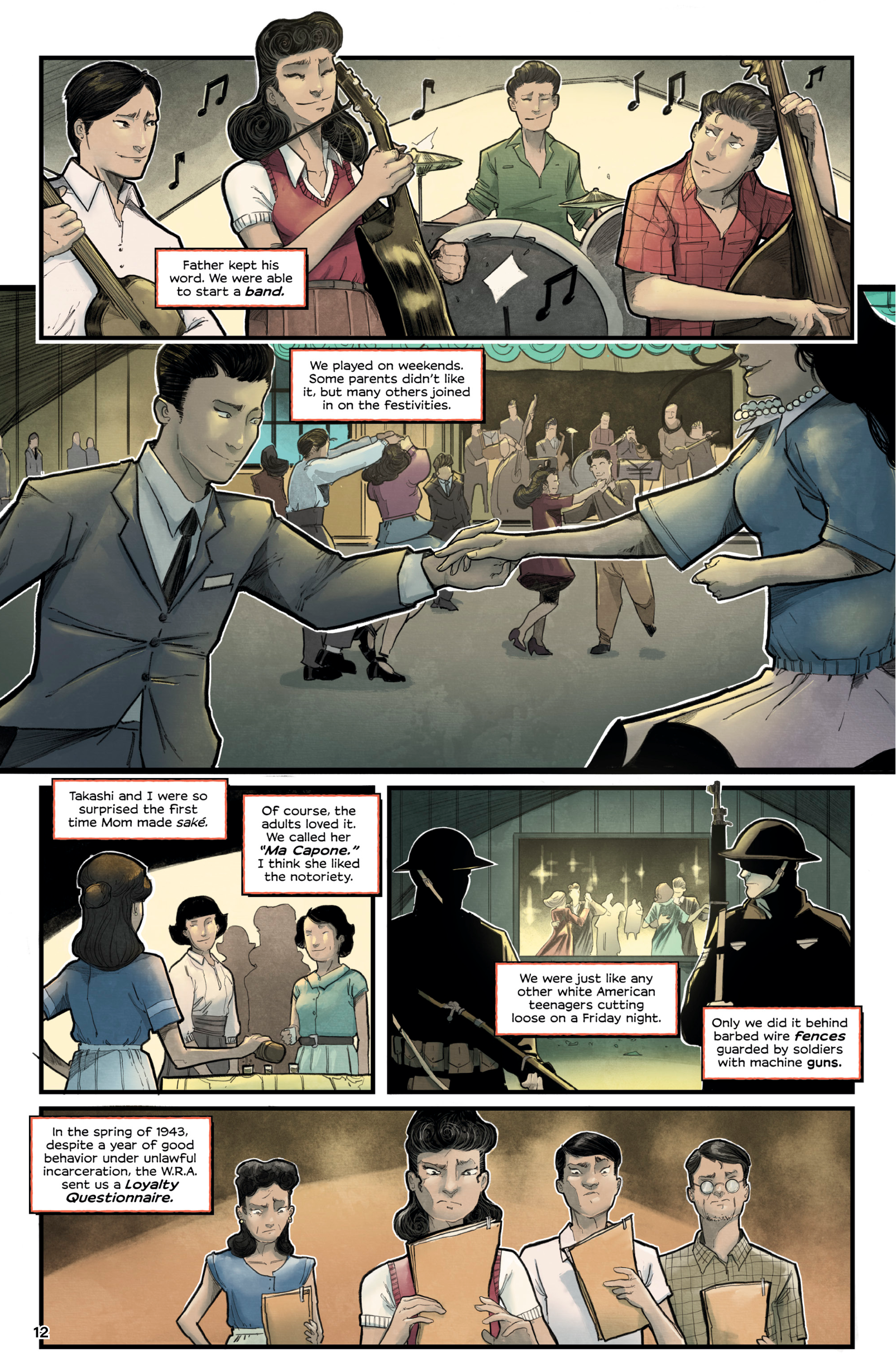
As mentioned, around two-thirds of those incarcerated were legal American citizens, and while keeping in touch with Japanese traditions was important to their agency, so were more “American” forms of self-expression like the band that Natsumi and Takashi form in panel 1 and the party depicted in panel 2. As Natsumi says in panel 4, “We were just like any other white American teenagers,” except for being “behind barbed wire fences guarded by soldiers with machine guns.”
This contradiction is expressed through the art with the first two panels showing their agency in embracing these festivities, while panel 4 zooms out to show the party framed and surrounded by two soldiers, who also stand out even more as framing elements due to being partly in silhouette. Another important framing element on this page is easy to miss, but that is the dark, shadowy arcs on the top of each panel. It is on one hand an art technique to guide the eye towards the focus of each panel, but it is also representative of an oppressive “dark cloud” over their happy activities.
Panel 3 shows a case of intergenerational resistance—though different generations had similarities and differences in their views on their situation, they came together to resist in their own ways, whether through dance parties or making saké, and the joke of “Ma Capone” shows how they were even able to find spots of humor in their situation.
The final panel shows the Watanabe family looking at their loyalty tests, which they all look at with raised eyebrows and frowns. The image alludes to the idea of balancing personal liberty and national security, and shows how people like the Watanabes might have felt about that “balance”—Natsumi’s observation that their loyalty was still questioned ”despite a year of good behavior under unlawful incarceration” shows that she probably believed before then that complying with incarceration was itself a show of loyalty, and it was insulting and degrading to still be questioned. Her indignation is a prelude to her later organized resistance in which she joins the Redress Movement and fights for reparations.
Why Comics Are a Powerful Way to Teach History
Kate Polak’s book, Ethics in the Gutter, speaks about historiometagraphic fiction, which “is meant to encapsulate works that deal with real-world events in fictional ways so as to comment on the way in which we shape narratives, receive them, and reframe them.” Two vital concepts to think about when analyzing historiometagraphic fiction like Natsumii’s War are point of view as entry and comics as avenues to ask ethical questions.
In contrast to traditional prose, where students learn to identify the difference between first, second, and third person, comics have a unique ability to highlight different points of view in different panels based on different art techniques, such as framing elements and character expressions. As mentioned before, this page makes heavy use of framing elements to guide the reader’s eye and highlight the feelings of the characters—”low-grade anxiety,” as it’s described in the comic.
In panels 1 and 6, the artist focuses on the expressions of groups of characters, emphasizing both their sense of community and their sense of common emotions. In panel 1, the kids are united in enjoying their band and finding a fun moment in horrible circumstances, and in panel 6, the Watanabe family is united in their indignation at being issued loyalty questionnaires. The focus on the feelings of the community highlight the importance of community in maintaining agency, and the facial expressions help readers connect with how the characters feel. Because the visual representations of feelings and emotions can often be more striking to viewers than simply reading about them, any ethical questions posed by the comic can be more impactful.
“The term historio-metagraphics is meant to encapsulate works that deal with real-world events in fictional ways so as to comment on the way in which we shape narratives, receive them, and reframe them.” Kate Polak, Ethics in the Gutter: Empathy and Historical Fiction in Comics (Studies in Comics and Cartoons)
In Conclusion
Comic books can bring history to life in the classroom in ways that traditional textbooks and curriculums cannot, providing deeper opportunities for students to connect with the events and people of the past and take lessons from them that they can use to impact their present. Order copies of Natsumi’s War for your classroom, sign up for our professional development webinars, and shop more of our inclusive catalog.
To hear all our latest updates, including new books, blog posts, and professional development opportunities, join our mailing list.
