
Jamie's Decisions: The Jerry Rescue Teaching Tips
September 10, 2026 | 13 min read
Teaching the Jerry Rescue with Comics
Quick Tips on Using Comics for Educators
Written by TrueFiktion Staff
The Jerry Rescue was an event when a group of activists forcibly liberated William “Jerry” Henry from the threat of the Fugitive Slave Act, but it is not often well-covered in its full historical context in traditional history curricula. Our book, Jamie’s Decisions, seeks to help fill that gap through the story of Jamie, a free Black man in Syracuse who decides to risk his own freedom to help his neighbor and to stand up against injustice. This blog post is a companion to Jamie’s Decisions, designed to give you a quick deep-dive on the Jerry Rescue, a list of solid primary sources, and guidance on how to use our comic book to teach in your classroom.
What Was the Jerry Rescue?
In Syracuse, New York, on October 1, 1851, a group of abolitionists forcibly liberated William "Jerry" Henry, a fugitive slave, from the custody of U.S. Marshals who were holding him for extradition to the South under the Fugitive Slave Act of 1850. The rescue was a significant moment in the struggle against slavery in the United States, highlighting the growing resistance to the Fugitive Slave Act and the determination of the abolitionist movement to defy political and religious authority in the name of freedom.
Despite the risk of prosecution, the rescuers successfully delivered Jerry to safety in Canada. Although some individuals were later arrested, none were ultimately convicted, making the Jerry Rescue a celebrated victory for the Underground Railroad and the fight against slavery.
What Is the Historical Context Around the Jerry Rescue?
In order to completely understand the Jerry Rescue, it must be framed within the context of antebellum America. While the Jerry Rescue was a fight for abolition, it fits into a larger argument over states’ rights and the appropriate degree of federalism leading up to the Civil War. Much of the debate surrounding the institution of slavery was framed in terms of federalism—either in ironic support of federal protections from the South, or angry accusations that the federal government was infringing upon Northern states’ sovereignty. Following the Fugitive Slave Act of 1850, there was a lot of tension between federal mandates and local resistance.
Additionally, the story of the Jerry Rescue and the overarching abolition movement cannot be separated from their religious context. Religion served both pro- and anti-slavery groups by providing the former with institutional support and authority and the latter with arguments of moral righteousness.
It is also important to note the distinction between abolitionists and anti-slavery activists when studying the Jerry Rescue and antebellum America in general. Abolitionists supported a total and immediate end to slavery and complete emancipation across the US, while anti-slavery advocates recognized slavery as a moral issue and agreed that it was ‘wrong’, but were not actively engaged in getting rid of the institution.
How Does the Jerry Rescue Fit into the Larger History of Abolition?
The Jerry Rescue story is an excellent example of a win for the abolitionist cause in antebellum America. The Rescue was part of a broader trend of abolitionist riots that sought to combat the immoral roles of both church and state in preserving the institution of slavery. The Jerry Rescue, while a dramatic example of success in the abolitionist movement, was not novel. Across America, in states like Ohio and Massachusetts, the abolitionist movement was turning to more extreme forms of civil disobedience to make their voice heard in opposition to the federal government’s unfair and cruel preservation of slavery.
Protesters during the Jerry Rescue used their morals to justify their actions by believing that the Fugitive Slave Law, which mandated the return of escaped slaves, was inherently unjust and violated their ethical principles of human freedom and equality. They argued that their moral duty to oppose slavery and protect an individual's right to liberty outweighed their obligation to comply with an unjust legal system.
On the other hand, the power of the church and state were symbiotic in the 1850s and both institutions threw their authority behind supporting the institution of slavery to appease Southern “slaveocrats” and prevent secession. When abolitionists and anti-slavery activists rose up in defiance, they were disobeying the authority of both the Christian church and the federal government.
It is estimated that over two thousand people joined in the dramatic effort to rescue Jerry from his captivity. Many were driven by abolitionist sentiments, and leaders later declared them the anti-mob party. However, the night's enthusiasm did not carry enough momentum in the movement, and the fiery promises made to the abolitionist cause soon became replaced with complacent hypocrisy.
Why Is the Jerry Rescue Relevant Today?
The Jerry Rescue was emblematic of anti-slavery antebellum Americans fighting to ensure equal socio-political rights for all Americans, regardless of race or background. We often see modern applications of this theme from various social groups representing people of different races, genders, sexualities, and religions to guarantee equality and fairness for all Americans.
The story of the Jerry Rescue holds much of its modern relevance in how it relates to contemporary forms of civil disobedience. The goal of protest is to disrupt the status quo to bring about positive societal change; in this way, the Jerry Rescue played a pivotal role in the abolitionist movement in 19th century America, and the courage to stand up in disagreement with unjust law and fight for the equal rights of all American citizens remains an integral part of our socio-political society today. The themes of civil disobedience and fighting for equality are significant in analyzing the Jerry Rescue's modern relevance.
Primary Source: Excerpt from the SPEECH OF REV. SAMUEL J. MAY, TO THE CONVENTION OF CITIZENS, OF ONONDAGA COUNTY, IN SYRACUSE, ON THE 14th OF OCTOBER, 1851, CALLED "TO CONSIDER THE PRINCIPLES OE THE AMERICAN GOVERNMENT, AND THE EXTENT TO WHICH THEY ARE TRAMPLED UNDER FOOT BY THE FUGITIVE SLAVE LAW," OCCASIONED BY AN ATTEMPT TO ENSLAVE AN INHABITANT OF SYRACUSE.
What it is: It is an excerpt of the speech that Samuel May gave to the people of Syracuse and the larger Onondaga County in the aftermath of the Jerry Rescue, when the government was trying to prosecute the participants in the Rescue.
Why we like it: It is a powerful speech that breaks down several reasons for saving Jerry, and an argument for why those who participated should not be prosecuted. Samuel May argues that the Jerry Rescue was firstly a moral and religious necessity, but also frames it in the broader American context as a continuation of the work of the American Revolution.
How to use it: This is a text that is intended to persuade its audience, and students can outline the arguments and also take note of the emotionally and religiously charged language that supports his arguments, in addition to the patriotic language that appeals to a broader American mythos. Students can also focus on the sense of unity that May speaks about—he describes the Jerry Rescue as a unanimous decision agreed upon by many disparate groups who didn’t necessarily have the same motivations. Students can brainstorm ways in which disparate groups can come together today for a common good.
What Are Experts Saying?
Dr. Angela F. Murphy is an Associate Professor of History at Texas State University specializing in mid-nineteenth century social reform movements of the United States and the Atlantic World, with an emphasis on antislavery, Ireland, and sectional politics in the United States. She has written several books, including The Jerry Rescue: The Fugitive Slave Law, Northern Rights, and the American Sectional Crisis (2016).
What do you find interesting about Jerry himself?
Jerry was an interesting figure because when they arrested him, they told him they were arresting him for crimes that he may have actually committed. Some reports say theft, and others insinuate domestic violence; but there is no way to know the veracity of these charges since he was not tried for those crimes after his arrest– they were an excuse to detain him as a fugitive from slavery. Jerry did not resist the arrest initially since he thought he was being arrested for the infractions stated, but he was not okay with being arrested as a fugitive and returned to slavery.
Although it may be hard to lift a man charged with such crimes up as a hero, it must be remembered that he was a man who took the initiative to seize his own freedom; he was trying to make a better life for himself, and he bravely tried to protect his freedom once arrested. Once he was sent to Canada by Underground Railroad agents, it was reported that he went to church and was known to be an upright and moral man. Sadly, he died just a few years after arriving in Canada.
What is the most misunderstood or misrepresented thing about the Jerry Rescue story and the broader context of the Fugitive Slave Act?
People often talk about the Jerry Rescue as if it were a violent rescue. While it was a forceful act to storm the building and grab Jerry, they tried really hard not to hurt people. The only people injured in the rescue were Jerry himself when he was pushed through the crowd because he was shackled, and one federal marshal who was injured in the fray. The marshal had a gun and tried to shoot into the crowd, but his hand was knocked up. Then, he jumped out the second-story window. He emerged with a broken arm.
Today, the Jerry Rescue is sometimes portrayed as pushing forward more violent resistance to slavery. While there were more episodes of violent resistance to slavery in the 1850s, most resistors wanted to go through legal means as much as possible. They focused on pushing people to vote for anti-slavery candidates into office.
Only when that consistently failed was there an increasing justification of violent resistance. Jermain Loguen, who had a lot of violent rhetoric against the Fugitive Slave Act, basically said he’d do what he had to do to protect himself if someone tried to take him back into slavery, and Frederick Douglass began saying the same thing. But both men saw it as a last resort. John Brown, the white abolitionist who is most associated with abolitionist violence and who led the insurrection at Harper’s Ferry, popped up in upstate New York at this time, too. Douglass and Loguen eventually became supporters of John Brown, but only when they had lost hope that slavery could be ended by peaceful means.
How to Read a Comic Page
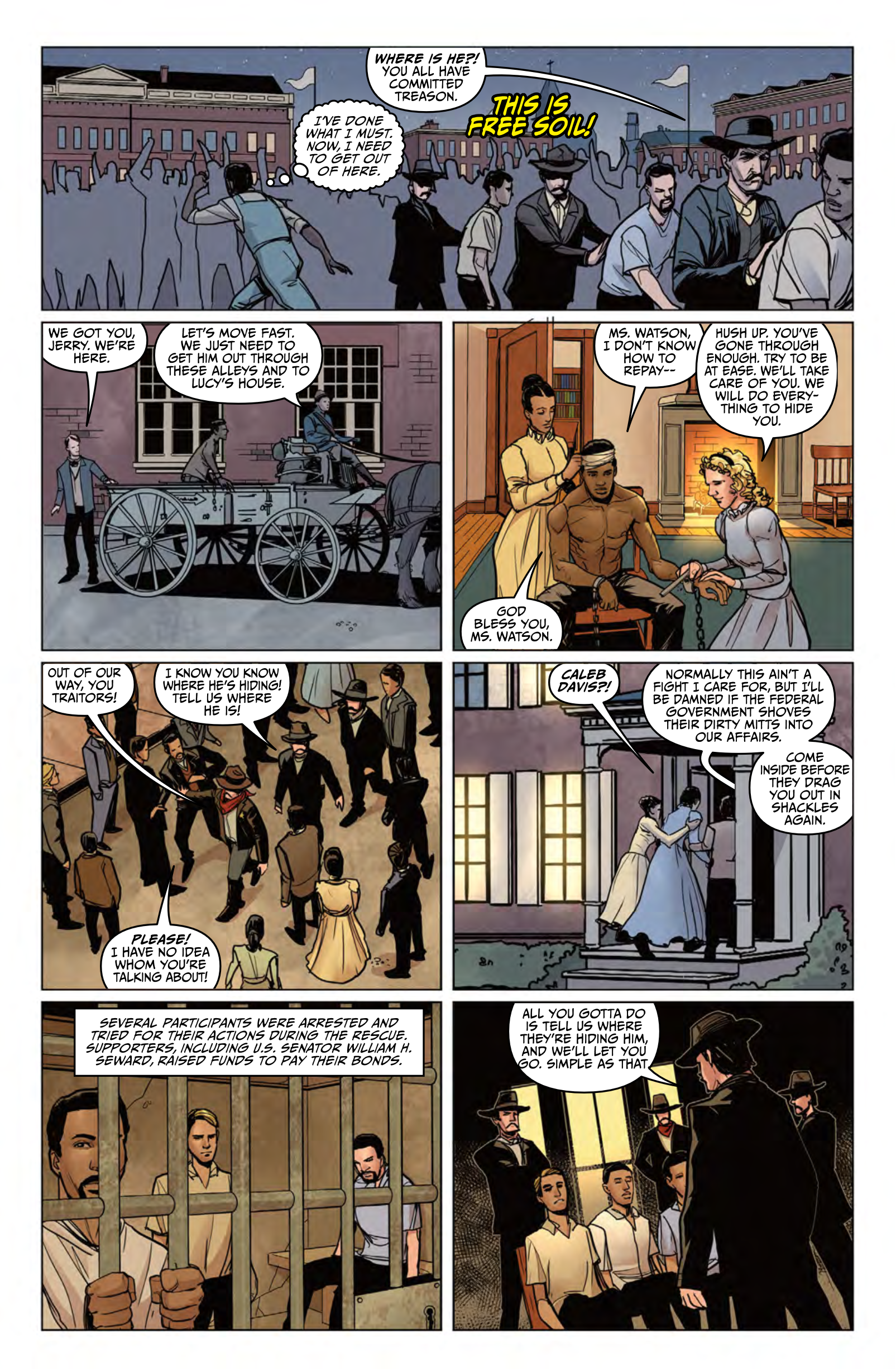
After the Jerry Rescue, some participants were arrested, and many participants fled the scene, knowing they had participated in civil disobedience to fight for equal sociopolitical rights for all Syracusans. In the first panel, Jamie runs from the marshals to avoid being captured as well, remembering that he participated out of both personal care for his friend and also out of a moral obligation he “must” fulfill.
The words “This is free soil!” in bright yellow letters are a great example of text hierarchy in comics—the eye is drawn to this text before any of the others because of its large size, bright and contrasting color, and boldface—and the letterer chose to do this to show what the prevailing attitude of the night was. Even though the marshal mentions treason and Jamie is running off, ultimately this was a victory for the abolitionists and anti-slavery campaigners of Syracuse.
While some members of the crowd participated simply because they believed it was the moral thing to do for religious, political, abolitionist, or anti-slavery reasons, others participated because they wanted to uphold states’ rights by not allowing the federal government to decide local policy. While the Jerry Rescue was a fight for abolition, it fits into a larger argument over states’ rights and the appropriate degree of federalism leading up to the Civil War. Much of the debate surrounding the institution of slavery was framed in terms of federalism -- either in ironic support of federal protections from the South, or angry accusations from people like Caleb Davis on panel 5 that the federal government was infringing upon Northern states’ sovereignty.
It was a very diverse group that came together to help Jerry, as shown in the following panels—the people helping him are men, women, Black, white, formerly enslaved, abolitionists, people who believed in anti-slavery, and, as shown in panel 5, even unexpected political allies. Many argued that their moral duty to oppose slavery and protect an individual's right to liberty outweighed their obligation to comply with an unjust legal system. Leaders previously shown in the book like Samuel May, Jermain Loguen, and William Garrison all had slightly different takes on why people should participate in the rescue, but they all agreed on the common goal of saving Jerry and carried it out.
The Jerry Rescue was part of a broader trend of abolitionist riots that defied the orders of both the Christian church and the federal government. Both institutions threw their authority behind supporting the institution of slavery to appease Southern “slaveocrats” and prevent secession. Therefore, when abolitionists and anti-slavery activists rose up in defiance, they were disobeying the authority of both the Christian church and the federal government. The Jerry Rescue became emblematic of anti-slavery antebellum Americans fighting to ensure equal socio-political rights for all Americans, regardless of race or background. We often see modern applications of this theme from various social groups representing people of different races, genders, sexualities, and religions to guarantee equality and fairness for all Americans.
Why Comics Are a Powerful Way to Teach History
Kate Polak’s book, Ethics in the Gutter, speaks about historiometagraphic fiction, which “is meant to encapsulate works that deal with real-world events in fictional ways so as to comment on the way in which we shape narratives, receive them, and reframe them.” Two vital concepts to think about when analyzing historiometagraphic fiction like Jamie’s Decisions are point of view as entry and comics as avenues to ask ethical questions.
In contrast to traditional prose, where students learn to identify the difference between first, second, and third person, comics have a unique ability to highlight different points of view in different panels based on camera angle and choice of subject. The tilted horizon line in panel 7 is notable for supporting the theme of resistance—it communicates a high-pressure situation with high stakes. The tilted horizon line was first used on page 1 to show how the Fugitive Slave Act shook things up in the community, and to communicate the tension of Jamie’s initial escape from slavery.
Using the tilted horizon again on page 7 connects the stakes here to the stakes on page 1—freedom is at stake. Additionally, the marshals fully surround the arrestees, and visually close in on them in the panel. The contrast between the tension and the straight, stoic posture of the arrestees being questioned emphasizes the strength and agency that the participants had in saving Jerry and in weathering the aftermath. Because the visual representations of an event can often be more striking to viewers than simply reading about an event, meaning that any ethical questions posed by the comic can be more impactful.
“The term historio-metagraphics is meant to encapsulate works that deal with real-world events in fictional ways so as to comment on the way in which we shape narratives, receive them, and reframe them.” Kate Polak, Ethics in the Gutter: Empathy and Historical Fiction in Comics (Studies in Comics and Cartoons)
In Conclusion
Comic books can bring history to life in the classroom in ways that traditional textbooks and curricula cannot, providing deeper opportunities for students to connect with the events and people of the past and take lessons from them that they can use to impact their present. Order copies of Jamie’s Decisions for your classroom, sign up for our professional development webinars, and shop more of our inclusive catalog.
To hear all our latest updates, including new books, blog posts, and professional development opportunities, join our mailing list.
