
Using Social Studies Comics for a Delano Grape Strike Inquiry: Gabriel’s Last Harvest
November 25, 2026 | 18 min read
Using Social Studies Comics for a Delano Grape Strike Inquiry: Gabriel’s Last Harvest
Quick Tips on Using Comics for Educators
Written by TrueFiktion Staff
The Delano Grape Strike is an important part of Filipino American and workers’ rights in American history, but is not often well-covered in traditional history curricula. Our book, Gabriel's Last Harvest, seeks to help fill that gap through the story of Gabriel, a Filipino American farm worker who participates in the strike to fight for his rights. This blog post is a companion to Gabriel's Last Harvest, designed to give you a quick deep-dive on the Delano Grape Strike, a solid primary source, and guidance on how to use our comic book to teach in your classroom.
What happened during the Delano Grape Strike?
The Delano Grape Strike began on September 8, 1965, when Filipino American grape workers, led by labor leaders like Larry Itliong and the predominantly-Filipino Agricultural Workers Organizing Committee (AWOC), walked out on grape farms in Delano, California, demanding better pay and working conditions. The strike gained significant momentum when Mexican American activist Cesar Chavez and his organization, the National Farm Workers Association (NFWA), joined the strike, broadening the labor movement and employing nonviolent tactics such as boycotts, marches, and fasts. The strike lasted five years and concluded in 1970 with a significant victory for the farm workers, leading to improved labor contracts and sparking a national movement for farm workers' rights in the United States.
What is often misunderstood about the Delano Grape Strike?
The historical gap in studying the Delano Grape Strike often overlooks the key role of Filipino workers and the racial divisions between Filipino and Mexican laborers, which were eventually bridged through unification, a crucial factor in the strike’s success. Companies traditionally used racial divisions to break strikes and keep working and living conditions as low and cheap as possible. However, the merger of the AWOC and NFWA into the United Farm Workers (UFW) in 1966 bridged this divide and was used as a point of unity instead.
Additionally, the national and global implications of the strike, driven by the innovative use of consumer boycotts, are frequently underexamined, despite their profound influence on labor movements and civil rights struggles worldwide. The Delano Grape Strike marked a turning point in tactics used by labor movements. They successfully turned the consumer boycott into their primary form of resistance, eventually leading to their new contracts and agreements in 1970 with growers. The Delano Grape Strike had far-reaching impacts all across America in urban and rural settings and even made international waves. When growers decided to sell their products in Europe to bypass hostile American markets, they were met with aversion because of the far-reaching network of sympathizers.
What does the Delano Grape Strike teach us about the resilience of the Filipino American and Mexican American communities?
During the Delano Grape Strike, strikers displayed resilience by uniting across racial lines, with Filipino and Mexican workers finding strength in solidarity despite past divisions, and building a powerful coalition that also gained support from diverse social groups. Filipino and Latino workers showed resilience by uniting behind a common cause. They worked together with various social groups and even consumers to present a united front against the harmful employment practices growers subjected them to.
The Delano Grape Strike lasted from 1965 to 1970, showing that leaders of the movement and the employees they represented were not willing to settle for anything other than fair and just contracts from their employers. Committed to a nonviolent, long-term strategy, they remained steadfast through years of hardship, using peaceful protests and boycotts to sustain their cause until they secured meaningful results. Leaders and strikers pledged strict compliance to non-violent methods of resistance during the Delano Grape Strike. This bolstered their moral mandate in the public eye but also created some tensions in periods of perceived loss, given that the strike lasted for five years.
Why is the Delano Grape Strike relevant today?
The Delano Grape Strike remains relevant today as modern labor conditions in many industries continue to deteriorate, with workers facing wage stagnation, exploitation, and unsafe working environments. Despite the gains won by the Delano strikers, unfortunately, in the years since the Strike, we have witnessed a backsliding in modern labor conditions in many sectors, including agriculture. The strike's legacy underscores the ongoing need for organized labor movements and collective action to secure basic rights and safe working conditions, reflecting persistent struggles in contemporary employment.
Primary Source: “The California Farm Workers' Struggle” by Cesar Chavez
What it is: An article by Cesar Chavez published in the Los Angeles Times on April 8, 1976. In it, Chavez writes about the progress the labor movement has already made in securing the rights of farm workers, and has a call to action for Californians to continue to aid them in the fight.
Why we like it: It is a firsthand account of the larger movement associated with the Delano Grape Strike, and it clearly lists the gains they have made, the obstacles they have faced, and what they need going forward.
How to use it: Students can follow Chavez’s outline of the efforts of the labor movement so far, and the gains they have won. Other interesting points to focus on could be Chavez’s mention of “inside” unions that work with the companies to prevent real gains from being made, and how the UFW was still able to win elections and progress. Also important to note is the heart of the article in the second to last paragraph— “The Farm Worker Initiative campaign will be difficult and expensive—expensive for the growers, who will spend millions to defeat it; difficult for the farm workers, who will sacrifice themselves and their time. But the growers have money, and we have time. We will match their millions with our bodies, our spirits and the goodwill of the people of this state.” This succinctly summarizes the heart behind the labor movement and all similar civil rights movements.
What Are Experts Saying?
Lorraine Agtang, a Filipino grape striker, began her activism at 14 years old. In 1975, she became the first manager of the UFW Paulo Agbayani Retirement Village that housed retired Filipino workers and organized farm workers for the first secret ballot elections. She is a lifelong activist focused on the contributions of the Filipino, Hispanic, Arab, Puerto Rican, and African American farm workers.
What was your personal experience during the strike? What was your role?
As a young person, I had already worked in the fields for years. At that time, there were no laws that prevented children from working in agricultural labor. Once the strike began, my father did not allow me to walk the picket lines. Instead, my friends and I spent time at the Filipino Hall, where the strikers gathered to eat meals.
We listened to their stories about the picket lines and about how Delano was changing. They talked about Robert Kennedy and other labor leaders coming to Delano to support the farmworkers. They also talked about how growers retaliated by closing the labor camps where the Manongs [first-generation Filipino immigrants to America] lived. The Anglo community largely opposed the strike because it affected their livelihoods.
Later, during the 1973 grape strike, our family walked out of the fields again. By then I was twenty-one years old. That action led me to become a volunteer with the UFW. I first worked at the UFW’s Rodrigo Terronez Farmworker Clinic. A year later, I became the first manager of the UFW’s Agbayani Retirement Village, which housed many Manongs who had been evicted from labor camps.
When the Agricultural Labor Relations Act was passed in 1975, giving farmworkers the right to secret-ballot elections to choose union representation, I asked to become an organizer. My role was to educate farmworkers about the law and their rights.
Now, I continue to tell the history of the Filipinos who started the strike and of the Manongs who never returned to work in the fields. I share their stories of struggle at conferences and schools, educating and motivating young people about the movement.
How did solidarity between Filipino and Mexican farmworkers develop, and what role did it play?
When the Filipino leaders asked César Chávez to join the strike, he was initially hesitant. He was organizing house by house and building a movement he believed could withstand a long battle with growers. He also understood that if he did not support the Filipinos during the strike, they would likely never join future labor actions.
Two weeks after the strike began, the Filipino leaders knew they could not win alone because many Hispanic farmworkers were continuing to work and breaking the strike. The Filipino leaders met with César Chávez, Dolores Huerta, and leaders of the United Farm Workers Organizing Committee (UFWOC) to ask them to join the strike. Once the two groups united, it was a healing time for me to see Filipinos and Mexicans coming together to fight for justice in the fields.
Both groups voted to come together to confront the growers. Historically, Filipinos and Mexicans did not work together or socialize much. It took strong leadership from both sides to model friendship and cooperation.
There is a story about when César first met Pete Velasco, an AWOC leader. They shook hands, called each other brother, and continued to do so for the rest of their lives. Leaders made sure workers ate together, met together, and spent free time together. The legacy of the movement was bringing two communities together, which made it possible to win the first agricultural labor agreement for farmworkers.
What is the most misunderstood or unknown part of the strike and boycott?
Some people believe that César Chávez and the UFW erased the Filipino role in starting the strike. Over time, many Filipinos in Delano returned to work because they had families to support, mortgages to pay, and children to send to college. Some were also unhappy with certain contract rules. As a result, many Filipino community members distanced themselves from the UFW.
César became the face of the movement, and because he was Mexican, public attention focused primarily on his leadership. But the Manongs never felt excluded. UFW staff, including César, continually thanked them for their contributions. Local Filipinos rarely visited the Manongs at Forty Acres, except for other Manongs living in Delano. As educators later began discussing Filipino involvement, some claimed the union excluded them from history. The truth is that many in the community did not maintain relationships with the Manongs and therefore did not know their stories. If the Manongs were still alive, they would say the UFW became their family. It is our responsibility to tell these stories.
Fred B. Glass is a labor historian, writer, and longtime labor movement organizer whose work focuses on the political, social, and economic history of working people in California. He is the author of From Mission to Microchip: A History of the California Labor Movement, a comprehensive and accessible account of labor’s role in shaping the state from the Spanish colonial era to the modern high-tech economy. He also served for many years as Communications Director for the California Federation of Teachers, bridging scholarship and activism through public history.
Why is Delano an important moment to study?
The United Farm Workers' struggle is the single most covered topic in American labor history. There is more written about it, more debate, and more films made about the farm workers’ struggle, beginning with Delano and even going back earlier, than about any other labor struggle in United States history. There are good reasons for that.
For one thing, it was, for a time, the most successful farm labor struggle ever to occur in the United States. The United Farm Workers today is a shadow of what it once was, but for about fifteen years, it was very successful in helping workers organize themselves, win better pay, improve working conditions in the fields, and achieve lives with a measure of dignity that they did not have before union contracts and before an effective union. The UFW built on the shoulders of earlier struggles, which its leaders understood well. It also arose at the peak of power of the broader labor movement, which meant that unions were in a position to support farm worker struggles in ways that had not been possible before. The UFW was the first farm worker union in United States history to last more than a few battles or a few years. That alone makes it important, especially because farm workers represent a large part of the workforce in this country, particularly in California. They are the people who put food on our tables, yet they have not enjoyed many of the benefits that others in this society take for granted.
The struggle is important to study for its successes, but American labor history is largely a history of defeats, and that is true of the United Farm Workers as well. But at the same time, there have been real victories won by the working class in America, including in California and even in Delano. Without those victories, conditions for working people here would look far more like those in fascist Italy or Nazi Germany. Still, we do have rights. They are under assault, but they exist because of those hard-fought victories.
There was one other crucial factor. This period coincided with other major mass movements that transformed American society: the civil rights movement, the early women’s movement, emerging LGBTQ struggles around 1970, and the rise of environmental activism. Because this was a time of broad-based social movements, the farm worker movement was able to draw on the understandings that those struggles had already created within American society, especially those shaped by the civil rights movement.
What do you think are the most relevant effects or impacts of the Delano grape strike today? Or what can people learn from it?
This was a moment when immigrant workers stood up collectively and were able to make real progress as a result of that collective action. That is an evergreen lesson from labor history, and the Delano grape strike is Exhibit A. It was a moment when immigrant workers achieved something they had never achieved before in the fields of California or in American society more broadly. The lesson of collective defense of immigrant worker rights is one the American labor movement has had to learn again and again since the nineteenth century. The origins of May Day, International Workers’ Day, reflect this history. May Day is fundamentally about the oppression of immigrant workers and the recognition that when one section of the working class is attacked, all workers are weakened. Conversely, when one section is lifted through collective action, it can strengthen the entire working class.
Hundreds of organizers and union leaders got their start working with the UFW in the 1960s and 1970s and went on to shape the broader labor movement. There is even a book that traces the careers of people who began their union work with the UFW, Beyond the Fields: Cesar Chavez, the UFW and the Struggle for Justice in the 21st Century, written by Randy Shaw, who runs the blog Beyond Chron in San Francisco. The sheer number of people involved speaks to the fact that the UFW was not just a union. It was a movement.
Marc Grossman is a veteran of the farm worker movement whose activism began in 1969 as a nineteen-year-old college student. Over the next fifty-plus years of his career, he dedicated himself to the movement, including more than two decades working closely with farm labor leader César Chávez as his speechwriter, press and personal aide. A graduate in American history from the University of California and with a master’s degree in journalism, Grossman has helped document, interpret, and communicate the story of the Delano grape strike and boycott.
How did the boycott become a central strategy?
In Cesar’s office/library at movement headquarters in Keene, California—now a unit of the National Park Service—you’ll find the complete works of Gandhi in dog-eared paperback volumes. Cesar read them all. One describes Gandhi’s 1930 salt boycott in the fight for Indian independence from Britain. Cesar also closely followed Dr. King’s work, beginning with the Montgomery bus boycott. He said that when he read newspaper accounts of the bus boycott, the words “flew off the pages at me.”
Cesar believed you couldn’t win with strikes alone. California in the ‘60s and '70s resembled the Deep South far more than Los Angeles or San Francisco. Growers controlled all the rural social, economic, and legal institutions—the courts, police, and politics. So the boycott allowed strikers to transfer the fight from the vineyards, where the odds were stacked against them, to the cities, where they had a fighting chance. Hundreds of strikers and their families fanned out across the U.S., Canada, and even Western Europe. They told their stories and organized support. They urged people not to buy grapes, then to boycott grocery stores that sold grapes. Hundreds of thousands picketed stores. Millions boycotted grapes. National labor leaders had never used a boycott like this, but it worked. A 1975 Louis Harris poll found that 17 million American adults were boycotting grapes during a second grape boycott.
The UFW built one of the broadest coalitions in the history of the American civil rights movement: Anti-Vietnam War college students standing next to hard-hat union construction workers who supported the war. Faith activists, minority groups, environmentalists, and labor households were all part of the same boycott movement. For many people from that era, the boycott is one of the things they remember most.
Was the UFW just a union, or was it something more?
Cesar and the other early organizers believed the union couldn’t just be about more money for your own people. That was important; they knew that unless the union made economic progress, it wouldn’t succeed. But they thought it had to be something more. It had to address the day-to-day abuses and prejudice workers faced in their communities. It had to support the struggles of other working people in related industries. Many farmworkers eventually went into food processing, packing houses, and other industries.
It’s ironic. Back in those days, and even today, Cesar’s critics condemned him. They’d say, “Oh, he wasn’t really a trade unionist; he wanted to lead a social movement.” They take his greatest strength and try to turn it into a weakness. I was with him through much of the ‘70s. Eighty-five percent of his time was spent on the union work, and especially on creating the infrastructure within the UFW to support that work. Once the Agricultural Labor Relations Act was passed in 1975 and workers finally could vote in union elections, the UFW won most of its elections. And because of that, it had to behave like a union. Cesar helped build that infrastructure around organizing, negotiating, and contract administration. That’s where the bulk of his time went. But for him, it wasn’t enough to create an organization that was only an economic institution. It had to be something else, too.
He and his colleagues believed workers aren’t just workers. Surely, only a union could remedy the abuses in the fields. But it would take more than a union, a movement, to remedy the daunting challenges workers faced upon returning to their communities—miserable housing, lack of educational opportunities, and genuine discrimination based on race and language.
I think especially today, most would agree it had to be more than a union, a movement. And many progressive unions today are very much in that tradition. Many of them were inspired by the UFW. And I think this desire to build a social movement, one concerned not only with workplace abuses but also with exploitation in the community, was one of Cesar’s greatest strengths.
How to Read a Comic Page
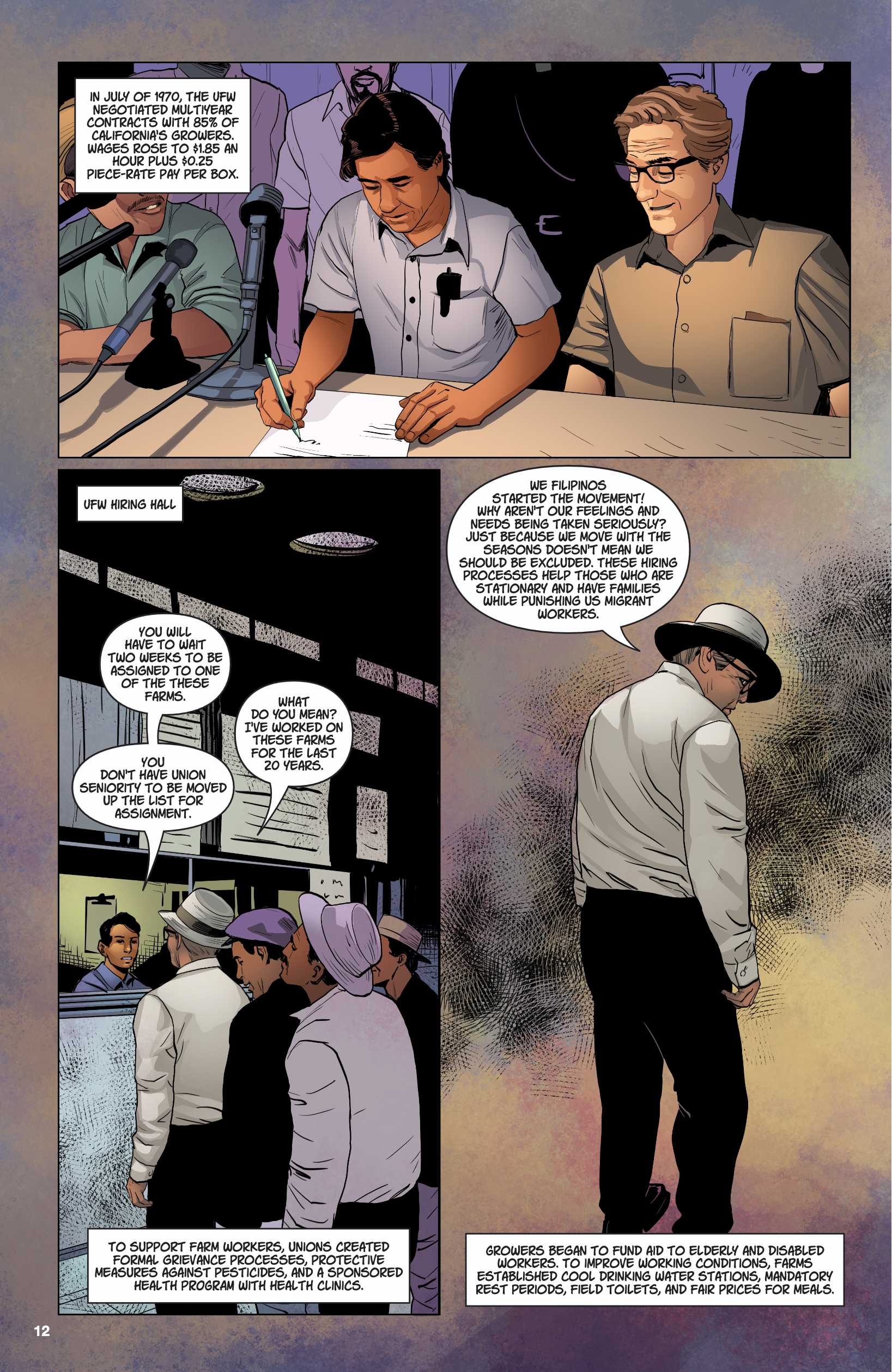
This page shows several important themes, summarizing the achievements but also the pitfalls of the efforts of the UFW. The first panel shows legislation being signed to help the farm workers. But despite national and even global impact, the second and third panels show that Filipino farm workers were still left behind. Earlier in the story, we see how Filipino and Chicano farm workers were able to unite and overcome racial divisions, but in the end, the new union rules favored stationary farm workers over migrant workers like Gabriel. In panel 3, the artist uses an inking technique called crosshatching to convey Gabriel’s mood, and the technique appears throughout the story, beginning on page 1, to create a sense of dread and injustice. The strongest association between this technique and that injustice appears on the final panel of page 8, where a protester is sprayed with chemicals and a dark splotch of crosshatching emanates from the point of impact. When crosshatching is used again on page 12, readers can feel that despite the long fight and the progress made, some of the old injustices still linger and negatively impact Gabriel’s life.
Why Social Studies Comics Are a Powerful Way to Teach History
Kate Polak’s book, Ethics in the Gutter, speaks about historiometagraphic fiction, which “is meant to encapsulate works that deal with real-world events in fictional ways so as to comment on the way in which we shape narratives, receive them, and reframe them.” Two vital concepts to think about when analyzing historiometagraphic fiction like Gabriel's Last Harvest are point of view as entry and comics as avenues to ask ethical questions.
In contrast to traditional prose, where students learn to identify the difference between first, second, and third person, comics have a unique ability to highlight different points of view in different panels based on camera angle and choice of subject. For example, on page 12, panel 2, the camera is placed behind the farm workers, almost as if we were in line with them. Generally, placing the camera behind characters helps us identify with them more as we literally see their point-of-view. However, in the following panel, the camera is again placed behind Gabriel, but his eye line is directed straight at the reader. While this does help us identify with Gabriel, it is also communicating a different mood of resilience despite not winning a full victory—even though Gabriel dejectedly remarks that Filipino farm workers were left behind despite starting the movement, he makes eye contact with the reader, which makes it feel like he hasn’t given up despite setbacks. Because the visual representations of an event can often be more striking to viewers than simply reading about an event, any ethical questions posed by the comic can be more impactful.
“The term historio-metagraphics is meant to encapsulate works that deal with real-world events in fictional ways so as to comment on the way in which we shape narratives, receive them, and reframe them.” Kate Polak, Ethics in the Gutter: Empathy and Historical Fiction in Comics (Studies in Comics and Cartoons)
In Conclusion
Comic books can bring history to life in the classroom in ways that traditional textbooks and curriculums cannot, providing deeper opportunities for students to connect with the events and people of the past and take lessons from them that they can use to impact their present. Order copies of Gabriel's Last Harvest for your classroom, sign up for our professional development webinars, and shop more of our inclusive catalog.
To hear all our latest updates, including new books, blog posts, and professional development opportunities, join our mailing list.
