
Using Social Studies Comics for an East L.A. Walkouts Inquiry: Sophia's Dream
November 25, 2026 | 12 min read
Using Social Studies Comics for an East L.A. Walkouts Inquiry: Sophia’s Dream
Quick Tips on Using Comics for Educators
Written by TrueFiktion Staff
The East Los Angeles Walkouts, also known as the Chicano Blowouts, were vital to the fight for Mexican American rights to equal education in America, but are not often well-covered in traditional history curricula. Our book, Sophia's Dream, seeks to help fill that gap through the story of Sophia, a young Mexican American student who participates in the East L.A. Walkouts in order to demand educational reform. This blog post is a companion to Sophia's Dream, designed to give you a quick deep-dive on the East L.A. Walkouts, a solid primary source, and guidance on how to use our comic book to teach in your classroom.
What happened in the East L.A. Walkouts?
In 1968, thousands of Mexican-American students from five East Los Angeles high schools staged a series of protests demanding educational reform. The students were protesting against unequal conditions in Los Angeles Unified School District high schools, including issues related to underfunding, lack of Mexican-American staff, and culturally biased curricula that ignored their heritage. These protests marked a pivotal moment in the Chicano Movement, significantly raising awareness of the educational inequalities faced by Mexican Americans and leading to changes in the educational system.
What are important historical contexts to understanding the East L.A. Walkouts?
The East LA Walkouts are often misunderstood as a sudden or isolated incident of Chicano protest, overlooking the fact that they were neither the first attempt at educational reform nor an abrupt reaction to systemic issues. This significant, student-led movement was deeply rooted in a long-standing resistance against the erasure of Chicano history and culture from educational curricula, highlighting a cumulative struggle for acknowledgment and change.
In East LA prior to the Walkouts, Chicano culture was often marginalized or entirely omitted from the school curriculum, reflecting a broader trend of cultural assimilation policies prevalent in educational systems at the time. This systematic exclusion not only deprived Chicano students of seeing their history and contributions reflected in their education but also reinforced a narrative that undervalued their cultural identity and heritage.
The East LA Walkouts in 1968 were part of a broader historical movement of Chicano and civil rights activism, following earlier efforts to address educational inequalities and discrimination in schools. Prior to these walkouts, there were numerous instances where Chicano communities organized and advocated for better educational opportunities and facilities, highlighting a persistent struggle for civil rights and educational reform.
The East LA walkouts were predominantly student-led initiatives, driven by young activists who organized through committees such as the United Mexican American Students (UMAS) and the Brown Berets, and disseminated their message via student newspapers like "La Raza" to coordinate protests against discriminatory educational practices. These efforts demonstrated the students' agency and leadership in demanding equal educational opportunities and challenging systemic injustices.
The Chicano community, including parents and individuals from other geographic areas, played a crucial role in the East LA walkouts of 1968 by providing support and solidarity to the protesting students, highlighting the widespread desire for educational reform and social justice. Their involvement underscored the collective effort to address systemic inequities faced by Mexican-American students in the Los Angeles school system.
How do the East L.A. Walkouts teach us about the resilience of the Mexican American community?
During the East LA Walkouts, Chicano students exhibited remarkable resilience by reclaiming their agency and challenging historical passivity imposed by the educational system. The East LA Walkouts of 1968 symbolized a powerful reclaiming of student agency, as Chicano students actively challenged and rejected the passive roles historically assigned to them within the educational system. By orchestrating and leading the walkouts, these students not only demanded improvements in their educational conditions but also asserted their rights and capacities to shape their own educational experiences and futures.
During the East LA Walkouts, students embraced and transformed the term "Chicano," which had previously been used derogatorily, into a powerful symbol of their unique political and cultural identity, distinct from the broader Mexican American categorization. This reclamation was a critical element in fostering a distinct Chicano culture that emphasized activism, resilience, and a profound sense of community pride, setting it apart from earlier Mexican American cultural expressions.
Why are the East L.A. Walkouts relevant today?
The East LA Walkouts remain profoundly relevant today, as they underscore the persistent de facto segregation in many school districts, driven by enduring residential and socioeconomic disparities, which continue to necessitate systemic educational reforms to provide equitable resources and opportunities. De facto segregation of Mexican American students in the East LA school district, a key catalyst for the East LA Walkouts, remains relevant today as many educational systems continue to experience similar racial and ethnic segregation due to ongoing residential patterns and socioeconomic disparities. This persistent issue underscores the importance of addressing systemic inequalities in education, advocating for equitable resources and opportunities to ensure all students can access quality education regardless of their background.
Additionally, these walkouts highlight the critical role of education in leveling the playing field, emphasizing the need for curricula and resources that are culturally responsive and tailored to prepare all students for success, ensuring that historical inequalities do not dictate future potentials. Understanding the role of education in preparing students for better opportunities and setting them up for success is crucial. One of the most direct outcomes of the walkouts was that California universities began targeted efforts to recruit more Chicano students into higher education programs. Recognizing these historical inequalities highlights the ongoing need for educational reforms that ensure all students receive the resources and culturally responsive curricula necessary to thrive in an increasingly diverse society.
Primary Source: Proposals Presented by the Educational Issues Coordinating Committee (EICC) to the Los Angeles Board of Education, March 28, 1968
What it is: The Proposals Presented by the Educational Issues Coordinating Committee (EICC), a group of students, parents, teachers, and other activists, to the L.A. Board of Education after the walkouts.
Why we like it: It outlines in relatively simple language what the participants in the walkouts wanted reformed, and to some extent how those things could be accomplished.
How to use it: Students can identify what kinds of specific inequalities the EICC was fighting against through the walkouts, and examples of practical ways these systemic inequalities could be addressed. They can also see how students demanded respect for Mexican American culture through specific examples like bilingual/bicultural education, culturally relevant textbooks, proportionate representation on school staff, and even authenticity in the preparation of school meals.
Overall, this source shows that there were systemic issues causing de facto segregation that harmed Mexican American students. Though their proposals were rejected by the board of education, who claimed their demands were too expensive, the students had exercised their agency to address the problems facing their community methodically and thoroughly.
What Are Experts Saying?
Dr. Ernesto Chávez is the Dr. and Mrs. W.H. Timmons Professor of Borderlands History at the University of Texas at El Paso. His studies focus on the American Southwest, specifically the intersection of race, class, and sexuality throughout ethnic Mexican- and Latino-American history. His work has been published in journals such as The Journal of the History of Sexuality, Pacific Historical Review, and American Quarterly.
What are the most important themes surrounding the East L.A. Walkouts?
The walkouts were a moment that really put the Chicano movement on the radar for people. Young people were taking control of their own education. Although the students got help from older people, they were the ones doing most of the organizing. They had agency and used it to confront the issues they saw in school. They would be punished for speaking Spanish in class and kept out of college-track classes. And this was all in the context of the Vietnam War, which was basically the only thing lying ahead of them. They took action with the help of teachers, the Brown Berets, and alumni of those schools, but the students really drove the action because they saw injustices, and they could do something about it.
How did 1960s culture impact the walkouts, and how was it impacted by the walkouts?
The walkouts became a nationally known movement. They were part of the overall 60s youth culture, but they had their own take on these notions of how one interacts with society. I think the walkouts became so famous because young people were behind it and taking action. They were the ones confronting the schools, their principals, the administration, and the school board – all while facing violence by the police.
The walkouts also helped raise people’s consciousness. Black people started calling themselves “Black” with pride, and it’s the same thing with Mexican-Americans, as they started calling themselves “Chicanos” to show their consciousness and sense of community. This consciousness helped the story spread to people around Los Angeles and then to Mexican-American communities in other states. Those communities outside of L.A. had their own walkouts because of the actions of these young people in Los Angeles. This movement really had an impact on other communities because they looked to East L.A. as a guidepost.
Dr. Mario Garcia is a twentieth-century historian with expertise in Chicano history, race and ethnicity, and Southwestern American history. He also received the Oral History Association's 2016 Stetson Kennedy Vox Populi Award and has authored twenty books on Chicano history.
What are the key themes to understanding the East L.A. walkouts of the 1960s?
I think a theme students should think about is the importance of empowerment. The East L.A. walkouts empowered the students who participated and helped them understand that they could bring about change. They had it within themselves to bring about positive changes in their educational opportunities. They became changemakers. By being involved in the walkouts, they stopped the schools from operating, and they forced the school board to negotiate with them and their parents and the community to improve their schools. Did they change everything? No, obviously not. Because we still have a lot of these problems today. But first and foremost, they changed themselves. They saw that they could empower themselves to bring about change.
But to be empowered, you have to have a sense of critical consciousness. I think Sal Castro got the students to understand the difference between schooling and education. Schooling is simply getting kids to accept the status quo. But education -- real education -- is getting them to think critically. Why are things as they are? Why are there still these differentials between Chicano students and Black students and other minority students compared to white students? That’s the kind of awareness that Sal Castro preached about.
What were the biggest student-driven things that happened during the walkout?
Well, Sal Castro was very key to the walkouts. It's possible that even without Sal Castro, there still would have been some kind of dramatic action since the conditions in those schools were so bad. But there's no question that Sal Castro was a major catalyst. Having said that, we shouldn't forget that the students created their own leadership. On some campuses, they organized committees that began to discuss the possibility of some kind of dramatic action. And the students spoke for themselves. In fact, one of the things that Sal Castro deliberately avoided during the walkouts was speaking for the students, so the students had to speak for themselves. Without those students, especially those in leadership roles, I don't think the walkouts would have been as significant.
How to Read a Comic Page
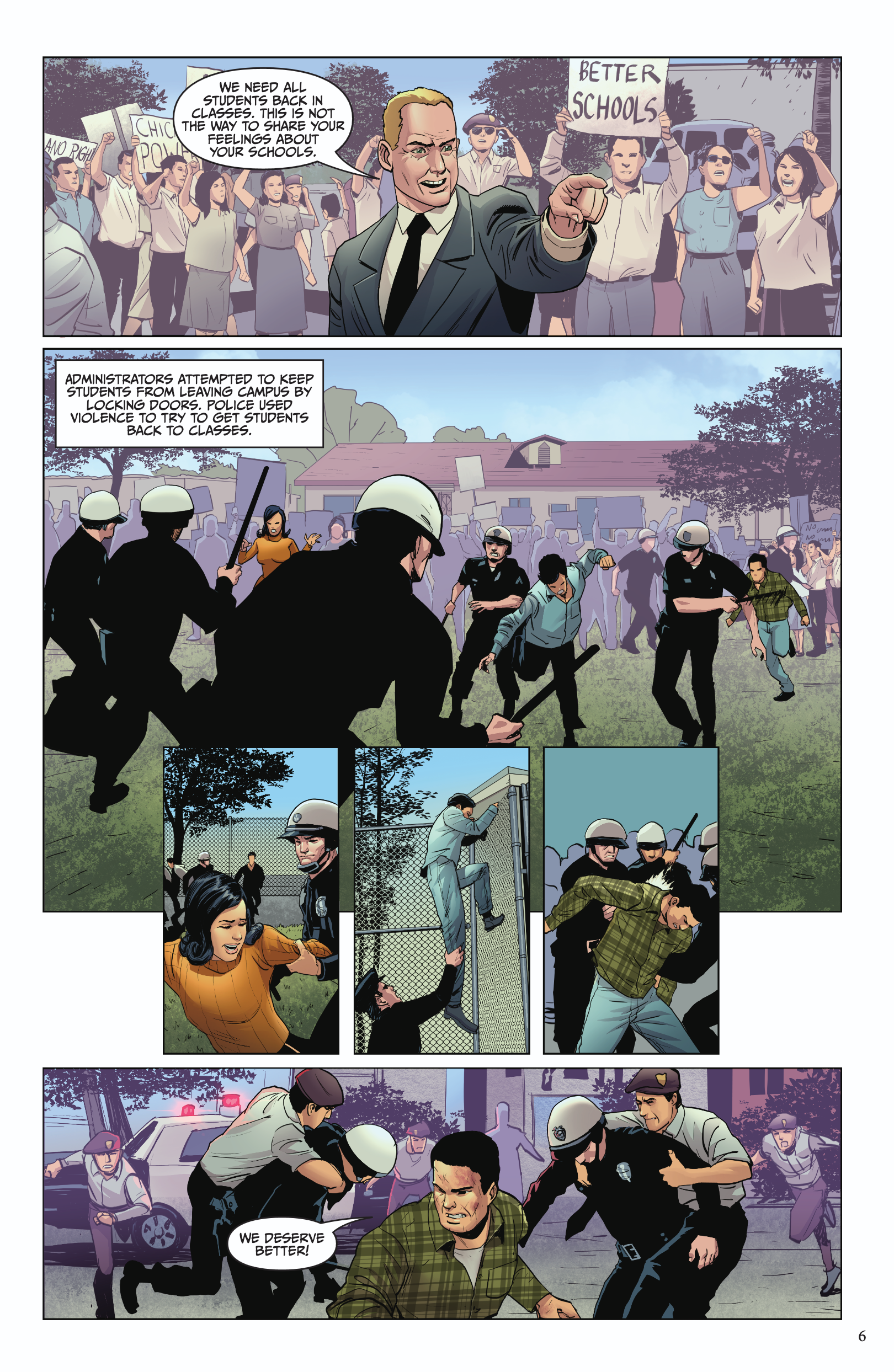
This page shows several important themes. In the first panel (and previous pages), we see the signs that students make to express their demands that de facto segregation be addressed so that they can have a better educational experience and environment that reflects their cultural identities. In the second panel, the use of color blocking shows how the violent police response to the student-led East L.A. walkouts underscores several important historical themes. The police uniforms are very dark-colored and stand out in the relatively light backgrounds, drawing the eye to the policemen immediately. Creating areas of maximum contrast is a common technique artists use to draw the eye to that area. Meanwhile, Sophia and her friends stand out from the background by wearing orange, blue, and green, and are interspersed between the colorless policemen, symbolizing how the police response aimed to break up the walkouts in a purposeful attempt at erasure of these students and their culture.
In the final panel, we see Sophia’s friend framed between two policemen, but they are framed by two Brown Berets coming to help the students. The positioning of the characters reflects that the walkouts were student-led initiatives that centered students and their needs, but the support from the Brown Berets shows that the walkouts were also part of a pre-existing, larger movement for reclaiming agency in the Mexican American community.
Why Comics Are a Powerful Way to Teach History
Kate Polak’s book, Ethics in the Gutter, speaks about historiometagraphic fiction, which “is meant to encapsulate works that deal with real-world events in fictional ways so as to comment on the way in which we shape narratives, receive them, and reframe them.” Two vital concepts to think about when analyzing historiometagraphic fiction like Sophia's Dream are point of view as entry and comics as avenues to ask ethical questions.
In contrast to traditional prose, where students learn to identify the difference between first, second, and third person, comics have a unique ability to highlight different points of view in different panels based on camera angle and choice of subject. One way that readers connect to characters is by seeing their facial expressions. This page has a panel focused on Sophia’s expression to show her feelings about what’s happening, and the last panel also focuses on her friend’s expression. Meanwhile, the police either have their faces mostly obscured by their helmets or are otherwise not the focus of the panel. This highlights the emotions of Sophia and her friends as the most important emotional stake of the page. Because the visual representations of an event can often be more striking to viewers than simply reading about an event, meaning that any ethical questions posed by the comic can be more impactful.
“The term historio-metagraphics is meant to encapsulate works that deal with real-world events in fictional ways so as to comment on the way in which we shape narratives, receive them, and reframe them.” Kate Polak, Ethics in the Gutter: Empathy and Historical Fiction in Comics (Studies in Comics and Cartoons)
In Conclusion
Comic books can bring history to life in the classroom in ways that traditional textbooks and curricula cannot, providing deeper opportunities for students to connect with the events and people of the past and take lessons from them that they can use to impact their present. Order copies of Sophia's Dream for your classroom, sign up for our professional development webinars, and shop more of our inclusive catalog.
To hear all our latest updates, including new books, blog posts, and professional development opportunities, join our mailing list.
