
Using Social Studies Comics for a Vicksburg Massacre Inquiry: Adele's Testimony
November 28, 2026 | 18 min read
Using Social Studies Comics for a Vicksburg Massacre Inquiry: Adele’s Testimony
Quick Tips on Using Comics for Educators
Written by TrueFiktion Staff
The Vicksburg Massacre is a very important event in Reconstruction-era American history, but is not often well-covered in traditional history curricula. Our book, Adele's Testimony, seeks to help fill that gap through the story of Adele, a Black woman who was present at the massacre and decides to testify in court and seek justice. This blog post is a companion to Adele's Testimony, designed to give you a quick deep-dive on the Vicksburg Massacre, a list of solid primary sources, and guidance on how to use our comic book to teach in your classroom.
What happened at the Vicksburg Massacre?
The Vicksburg Massacre (December 7, 1874) was a violent episode during Reconstruction in the South. White paramilitary groups attacked African American citizens who had organized to protest the removal of Peter Crosby, a Black sheriff, from office, resulting in the deaths of 75-300 Black individuals. The event highlighted the backlash against Reconstruction efforts to empower African Americans, underscoring the fragile nature of Black political rights in the face of violent white supremacy. This massacre was a pivotal example of the systemic and violent resistance to racial equality and the federal government's waning commitment to protecting African Americans in the South.
What led up to the Vicksburg Massacre?
After the war, a divide emerged between the ideal of preserving the Union and the endowment of equal rights for Black Americans. Protests against Reconstruction often framed white citizens as victims of federal overreach and African American empowerment. This narrative, which portrayed Black political gains as a direct threat to white governance and superiority, directly influenced the withdrawal of federal and state support for Reconstruction policies and reinforced racial hierarchies in the South.
White paramilitary organizations like the "Tax-Payers' League" and the “White Leaguers” used violence and intimidation to dismantle Black political power and reinforce racial hierarchies. Organizations formed by white landowners and business elites in the South to oppose Black political power and Republican-led governments. They claimed to fight against "wasteful spending" and high taxes, but in reality, they worked to undermine Reconstruction policies that funded public schools, infrastructure, and other services that benefited newly freed Black citizens.
How does the Vicksburg Massacre teach us about the resilience of the Black community?
Despite resistance, African Americans like Peter Crosby rose to prominence as political leaders, embodying the resilience of Black communities determined to achieve self-governance and freedom with independence. Their leadership reflected a broader struggle to secure the political, economic, and personal rights promised during Reconstruction – Black veterans were prepared to defend their newly received constitutional rights against prevailing white supremacy. However, their progress was met with intense opposition, particularly from white citizens who, driven by economic grievances and racial animosity, sought to undermine Black political and social advancement by any means necessary.
Black churches played a central role in organizing African American communities during Reconstruction, serving as hubs for political activism, education, and social support. In Vicksburg and other parts of the South, these institutions provided a safe space for African Americans to strategize and unite, fueling protests like those against the removal of Peter Crosby and bolstering collective resilience in the face of white supremacist violence.
Black women witnesses played a crucial role in documenting the brutal violence, ensuring that the atrocity was not erased from history despite the perpetrators escaping justice. Through their testimonies, they provided firsthand accounts of the massacre, detailing the indiscriminate killing of Black citizens and the white supremacist motives behind the attack. Their resilience was evident not only in their willingness to speak out despite the danger but also in their efforts to preserve the truth in the face of widespread intimidation and systemic oppression. Without their courage and persistence, much of what we know about the massacre today would have been lost, as official records often ignored or downplayed racial violence during Reconstruction.
Why is the Vicksburg Massacre relevant today?
The violent white paramilitary response to Black empowerment during Reconstruction set a precedent for systemic racial oppression in the Jim Crow era. This backlash underscored the fragility of progress in the face of deeply entrenched racism. The events of the Vicksburg Massacre and others like it have been largely excluded from mainstream historical narratives, diminishing their significance in public memory. This erasure perpetuates ignorance about the systemic violence of Reconstruction’s undoing.
Economic grievances were weaponized to incite the Vicksburg Massacre of 1874, as white conservatives stoked fears of Black political and economic advancement, targeting Black leaders who had gained influence during Reconstruction. This same tactic—framing economic anxieties as a justification for undermining minority leadership—has persisted into the modern era, where accusations of corruption and incompetence continue to be used to delegitimize Black political figures. The Mississippi Plan of 1875, which formalized voter suppression through intimidation and fraud, set a precedent for systemic disenfranchisement that echoes in contemporary efforts to restrict voting rights and limit Black political power.
Primary Source: Legal Document from Mississippi Governor Adelbert Ames; December 4, 1874
What it is: A proclamation from the governor of Mississippi at the time, Adelbert Ames, ordering the mob that forcibly removed Peter Crosby and other elected officials to disperse and go home, issued days before the Vicksburg Massacre actually started.
Why we like it: It shows what the government response was to Black people’s civil rights being violently threatened in the Reconstruction era, and also shows that though gestures were made to protect Black civil rights, ultimately the government did not do enough to protect them and the Vicksburg Massacre was still able to happen a few days later.
How to use it: Students can read what the governor’s understanding of the situation was. He knew that the lives of Black officials specifically were being threatened by angry white mobs, but the most he did to prevent further violence was issue a proclamation that the mobs disperse and go home, despite the fact that they had already committed crimes. It is also notable that Governor Ames invokes the Constitution in his proclamation, which shows a general agreement in the government that the Constitution upholds the rights of Black people.
What Are Experts Saying?
Dr. Beth Kruse earned her Ph.D. in 2021 from the University of Mississippi. Her dissertation challenged understandings of the Civil War era by centering the experiences of prisoners of war and the military prison communities. Her case studies included USCT and their fight for citizenship rights, southern-sympathizing women living in the north aiding CSA prisoners, and soldiers’ creation of economic markets within the prisons. The case studies revealed the degree of influence these historical actors exuded regarding the various prison policies in the north and south.
Why is it important to study the Vicksburg Massacre?
It is important to study Vicksburg because, while historians recognize that Reconstruction did not fail on its own, there was a deliberate attempt to overthrow it. However, the general public often assumes that Reconstruction collapsed without outside resistance. In reality, it was overthrown in Vicksburg, and it is fully documented in congressional hearings, newspapers, the involvement of the US Colored Troops, and more. It is especially powerful to hear the story of how Reconstruction was overthrown through the experiences of everyday people.
However, their stories were erased from the history of Vicksburg. It was largely buried until Dr. Albert Dorsey, Jr. brought it to light through his research. He wrote his dissertation about the Vicksburg Massacre, which brought back the attention of the local population, and from there it has grown. We've now created an ArcGIS StoryMap. We've had a remembrance weekend. We found descendants of both African American Vicksburg residents and the white perpetrators. One of the white descendants was integral in making sure that a historical marker was put up on the county courthouse, which we did on Juneteenth. There are only a few Reconstruction-era historical markers in Mississippi. One is now in Vicksburg. We plan to continue teaching about Vicksburg so that this event will not be erased from history again.
What are some critical themes to understanding Vicksburg?
Often, we think of the Civil Rights Movement as a unique time, but there is a long history of the Movement, and it started in Reconstruction. Some people even say it started before that with slave rebellions, but the foundation was laid in the Reconstruction era through grassroots activism by African Americans. During Reconstruction, they organized and marched. They gathered in churches and talked about politics and how to fight for their civil rights. Black men were often accused of going to the wrong polling place to register, so they were denied the right to vote, and they wanted to fight against that. They marched peacefully into town to show that their elected officials couldn’t be simply thrown out, but they were met by armed and organized ex-Confederate and Union soldiers who now aligned with the Confederates over the issue of race.
Many ex-Union soldiers married into Southern families, so they had economic motivations—they couldn’t afford to be ostracized by the white people. Some of the former USCT bought their guns when they left the army, but most of the Black protesters did not have guns. So, ex-Confederates and ex-Union soldiers rode out to meet the largely unarmed African Americans who were trying to come to town and peacefully protest for their rights. The White Leaguers shot them.
During the ensuing trials, many women came forward to testify the same way Fannie Lou Hamer and Mamie Till-Mobley did in the Modern Civil Rights Movement. These women had no rights. They couldn’t vote or sit on juries, but here they were participating in politics by testifying in congressional hearings. They stood up and identified the men who killed their husbands, often based only on physical description because they didn’t know the killers’ names. They often described the White Leaguers by their horses, which in the 19th century was a reliable way to identify someone. It is important to see Black activists in Vicksburg during Reconstruction as part of the history of the Civil Rights Movement.
Vicksburg was a microcosm of what was happening across the South. Ku Klux Klan violence started right after the Civil War. Union Enforcement Acts effectively eliminated the Klan in the 1870s, but racism and violence did not stop just because the Klan formally disbanded. The White Leaguers, who were often former Klan members, continued what they started. This was not just happening in Mississippi; there are congressional reports from South Carolina, Georgia, Alabama, and Louisiana of atrocities inflicted on African Americans, largely during night rides. These groups’ goal was to terrify African Americans, to keep them from enrolling in voting polls and participating in civic life. If Black people were able to vote, they elected people who aimed to create services that would be equal for all. This situation was not unique to Vicksburg; it happened across the southern states.
The Colfax Massacre happened just before the Vicksburg Massacre, and here in Mississippi, there was the Clinton Massacre and the Yazoo City “Tragedy.” Lynchings also increased. It was reported in local and national papers, but it is difficult to find Black newspapers. There was a Vicksburg newspaper, The Golden Rule, owned by a Black man named W.E. Mollison. Only two of his newspapers still exist, so we don’t know how the Vicksburg Massacre was remembered in Vicksburg’s African American newspapers. I have not yet found any report on the 1874 Massacre in 19th-century African American papers, despite heavy local and national coverage. The national illustrated paper, Harper's Weekly, wrote about the Mississippi and Louisiana events.
Their reporting included a full-page front cover image of Gen. Sheridan and his "Banditti" letter. Sheridan urged Congress to declare the White League members "banditti" so the military could arrest and try them under military law. Historians wrote massive books about Reconstruction, but they are hard to read if you’re not a historian. However, the individual stories of the people involved were well-documented, and we can ask questions about common life struggles. How did they fight for their family? How were they successful? How did they die? How did those who survived go on after that? There is a common human experience that is also important for us to understand and relate to.
Dr. Albert Dorsey Jr. earned his Ph.D. in United States History from Florida State University in 2012. His teaching and research interests include African American history, the American Civil War and Reconstruction, Black land ownership in Mississippi, the long civil rights movement (with a particular focus on Black intellectual protest rhetoric) and the history of jazz music. His forthcoming book is entitled Vicksburg’s Massacre: The Complexities and Consequences of Black Participation in the Body Politic and Land Ownership in the Age of Redeemer Violence.
What was the political climate in Vicksburg and Warren County prior to the massacre?
It was very complicated. There is a dearth of primary sources that remain hidden because Vicksburg was an apartheid city. Slave owners used divide and conquer techniques to keep Black people from joining together—they created dichotomies between enslaved people who worked in the fields versus in the house; light-skinned versus dark-skinned Black people. Enslaved people who were children of the plantation owner had a higher status than field workers. People who proved themselves loyal to their owners had a higher station, perhaps living in or near the big house. There were enslaved people who were drivers—Black people who did the actual whipping at the command of the overseer, who was a white man on horseback on the plantation.
The institution’s divide-and-conquer strategy was diabolical. When you have these apartheid structures, people are going to do the best that they can for themselves at any cost. If they have a higher station, they're going to do what's necessary to protect that higher station. That's what made it so convoluted, and so problematic, and so hard to break up. Vicksburg was like that for a very long time. People didn’t inquire and weren’t allowed to be curious, and if they were, they’d be slapped on the hand (metaphorically) for asking questions.
How did the Civil War and Reconstruction provide opportunities for social change?
Anecdotally, an example would be Benjamin Montgomery. He was owned by Jefferson Davis and Joe Davis, Jefferson’s older brother. They bought Benjamin Montgomery from Virginia and made him work at Briarfield Plantation. They had several hundred human beings enslaved there. Benjamin Montgomery oversaw the entire plantation when Jefferson Davis went off to become president of the Confederacy. Benjamin Montgomery, a literate African American man, was left in place to oversee the plantation. After Jefferson Davis was jailed, Joe Davis eventually sold Briarfield to Benjamin Montgomery at a jacked-up price. Montgomery then planted and harvested cotton and other products for the Union. Montgomery had an enormous debt because of the price he paid for Briarfield, so he ruled Briarfield with an iron fist, just as if he were the master. He set up a government and police force. When people got out of line, they were punished with whippings. Montgomery produced cotton for the Union government between 1863 and 1865. He was building economic power. It was very different than the 40 acres and a mule idea that was set up by William Tecumseh Sherman. The Freedmen's Bureau oversaw the entire South, but there was no 40 acres and a mule for Black people after Andrew Johnson assumed the presidency. Johnson gave back the land to former Confederates.
Peter Crosby enlisted in the Union Army in 1864 and, after the war, went back to Vicksburg. He escaped from a Mississippi plantation and was one of many Black men to enlist in the army in Vicksburg because of the Union Army’s strong presence there. By 1870, Black people had full political power because of the 15th Amendment. They wanted to build economic power by buying and selling small plots of land whenever white landowners would sell to them. People like Peter Crosby built political power by running for local office. White Vicksburg residents refused to serve under former slaves, people that they had owned just 5 to 10 years prior, and sought to take back political power through the Vicksburg Massacre. But, the larger fight was with the federal government—sort of a continuation of the Civil War, not necessarily on the battlefield against armed Union soldiers, but against the Black people who were gaining political and economic power at the local scale.
What are the most relevant effects of the Vicksburg Massacre today?
Mississippi is complicated, and the folks in Vicksburg are no different. There's a lot of embarrassment around the conversation about slavery and lynch mob violence. Mississippi lynched more Black Americans than any other state in the country. They lynched people for being “uppity,” acquiring power, acquiring education, acquiring a little bit of land, being a school teacher, buying a piano when many poor white folks couldn't afford to buy a piano. That's embarrassing in the 21st century, and so for the last 50-60 years, a lot of important white Mississippians, particularly Vicksburgers, have tried to hide their history. It was very difficult to uncover this story, and it’s still not complete because there are people who preside over a lot of primary source documents and won't give them up. They want to maintain the status quo and hide the history. There's only so much you can do with land deeds, census records, tax records, and so on.
The Vicksburg National Military Park wasn’t even a space for Black people until the present day. National military parks like Gettysburg, Vicksburg, and Chancellorsville have these giant, beautiful structures dedicated to both the Union and the Confederacy. The Vicksburg Park didn't get its first commemoration to African American soldiers until the 2000s, well over 100 years after the Park was founded. It's still the only structure there dedicated to African American soldiers today. The legacy of hiding and whitewashing the truth still remains, and it remains very difficult to have conversations around Vicksburg with both white and Black people. Vicksburg is still controlled by the white power structure. There are a lot of comfortable middle-class Black people and Black legislators, but the white power structure still remains in control.
We talk about inequity. We talk about “diversity, equity, inclusion,” but do we mean it? Do we really mean it as a society? The United States prides itself on being the greatest country on Earth. I don't think so, but we have the potential to be. As an amateur boxer, you're not going to be among the top on Earth unless you critique yourself every single day and try to get 1% better every single day. That methodology can be applied to athletes or graduate students, or anyone, really. Try to get 1% better. Where am I weak? Where can I improve? The problem is that society is reluctant to change its bad behavior. They're not ready to make changes yet because it's going to cause a bunch of people discomfort. That's the problem.
How to Read a Comic Page
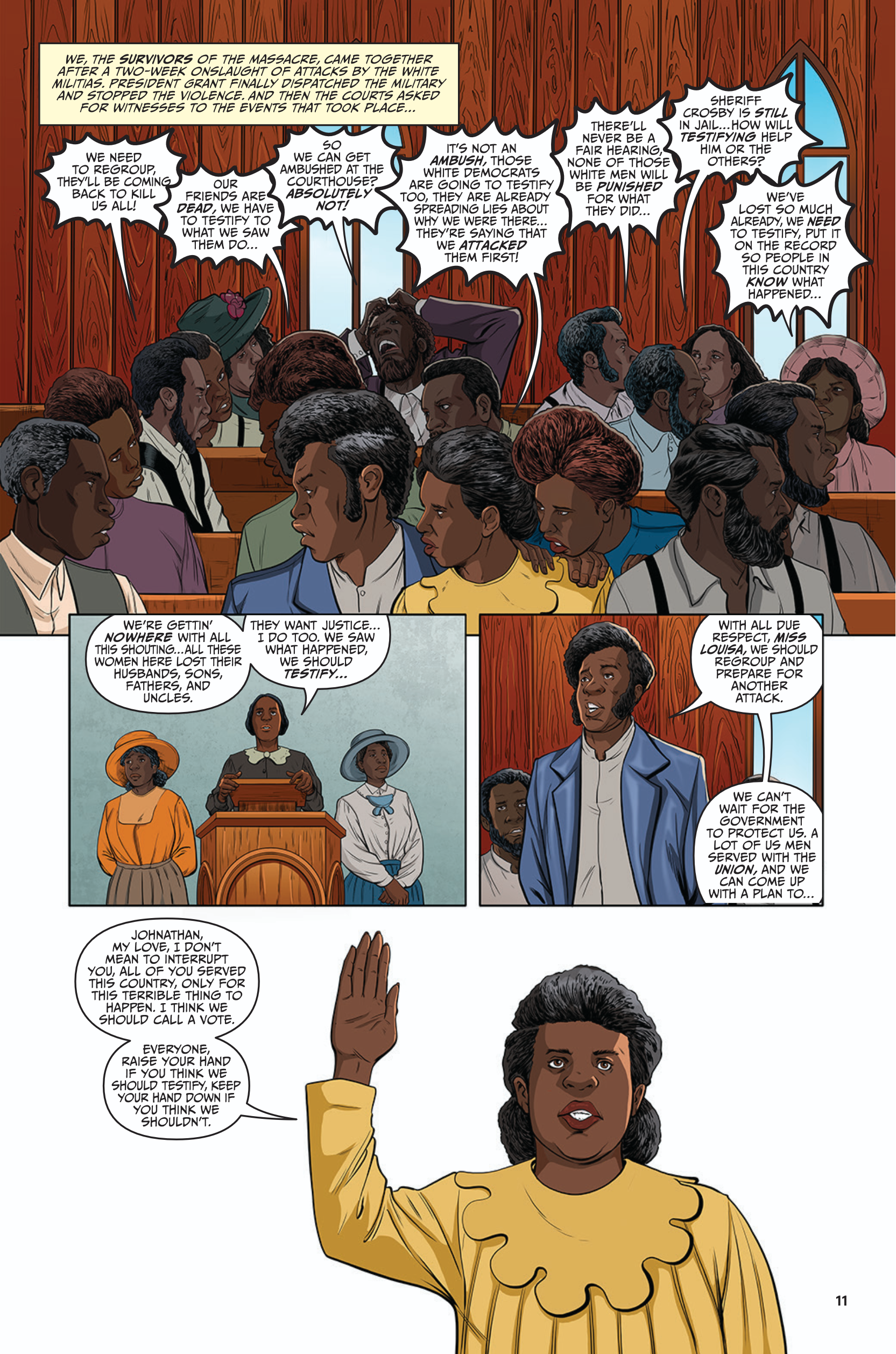
This page is particularly important for highlighting the resilience of the Black community after the Vicksburg Massacre. The first panel shows the survivors gathered together to discuss their next move, but it is very chaotic—the speech balloons are spiked, indicating volume and strong emotions, and the tight grouping makes the space feel crowded and disorganized, reflecting the thoughts and feelings of the people in the room. Adding to the atmosphere of fear and anxiety is the fact that many of the facial expressions are only partly shown, and they are all looking nervously in different directions, and readers subconsciously interpret that as more chaotic. The community is reacting to the impossible situation they’ve been put in of trying to protect Black political power and civil rights against white paramilitary groups when they know that the perpetrators will likely not be punished by the law.
The second panel shows three women, one of whom is Louisa, who is leading the meeting and calling for everyone to settle because she proposes that they should testify. When Jonathan challenges her, Adele speaks up, and the background falls away, leaving Adele front and center with her right hand raised. The way she is raising her hand is foreshadowing that she will testify in court. The background being completely white despite previous panels showing that they are in a wood-paneled building makes Adele stand out even more and highlights this as a very important character moment. The chaotic background from the first panel does not affect Adele anymore as she comes to a decision in the final panel that she and the other women should testify. The women witnesses were leaders of their community in deciding how to handle the atrocities that were committed against them and how to prevent the erasure of history.
Why Social Studies Comics Are a Powerful Way to Teach History
Kate Polak’s book, Ethics in the Gutter, speaks about historiometagraphic fiction, which “is meant to encapsulate works that deal with real-world events in fictional ways so as to comment on the way in which we shape narratives, receive them, and reframe them.” Two vital concepts to think about when analyzing historiometagraphic fiction like Adele's Testimony are point of view as entry and comics as avenues to ask ethical questions.
In contrast to traditional prose, where students learn to identify the difference between first, second, and third person, comics have a unique ability to highlight different points of view in different panels based on camera angle and choice of subject. As mentioned before, panel 1 shows the general feelings of fear and chaos through speech balloons and the eyelines of the characters going in all different directions. However, the placement of Jonathan and Adele in the bottom center of the panel is also important and adds to the meaning. They are looking with concern at their neighbors, but they are huddled down at the bottom of the panel as the chaos and fear surrounds them in the form of the shouting crowd. The crowd visually crowds them in, with the speech balloons hanging over everyone’s heads, and this creates a feeling that Jonathan and Adele are hearing everything the people in their community are saying and feel almost crushed by the weight of the decisions in front of them. The framing of the panel enhances our understanding of the characters’ feelings. Because the visual representations of an event can often be more striking to viewers than simply reading about an event, meaning that any ethical questions posed by the comic can be more impactful.
“The term historio-metagraphics is meant to encapsulate works that deal with real-world events in fictional ways so as to comment on the way in which we shape narratives, receive them, and reframe them.” Kate Polak, Ethics in the Gutter: Empathy and Historical Fiction in Comics (Studies in Comics and Cartoons)
In Conclusion
Comic books can bring history to life in the classroom in ways that traditional textbooks and curricula cannot, providing deeper opportunities for students to connect with the events and people of the past and take lessons from them that they can use to impact their present. Order copies of Adele's Testimony for your classroom, sign up for our professional development webinars, and shop more of our inclusive catalog.
To hear all our latest updates, including new books, blog posts, and professional development opportunities, join our mailing list.

×