
Using Social Studies Comics for a First Great Migration Inquiry: Edward and Louise's Journey
November 28, 2026 | 15 min read
Using Social Studies Comics for a First Great Migration Inquiry: Edward and Louise’s Journey
Quick Tips on Using Comics for Educators
Written by TrueFiktion Staff
The First Great Migration was a monumental event in American history, but is not often well-covered in traditional history curricula. Our book, Edward and Louise's Journey, seeks to help fill that gap through the story of Edward and Louise, a Black couple from the South who are dissatisfied with Reconstruction and decide to move North for greater opportunity. This blog post is a companion to Edward and Louise's Journey, designed to give you a quick deep-dive on the First Great Migration, a list of solid primary sources, and guidance on how to use our comic book to teach in your classroom.
What was the First Great Migration?
The First Great Migration (1916-1940) saw a mass migration of African Americans from the rural South to urban centers in the North and Midwest, driven by economic opportunities in industrial jobs and the desire to escape oppressive Jim Crow laws. This demographic shift dramatically altered the racial composition of cities like Chicago, New York, and Detroit, contributing to the growth of African American cultural and political movements. However, migrants often faced new forms of racial discrimination in housing, employment, and social services, reshaping racial dynamics in the North.
What are common misconceptions about the First Great Migration?
Understanding the persistence of northern racial discrimination during the First Great Migration is crucial, as it reveals how systemic barriers persisted even outside the Jim Crow South, shaping the experiences of African American migrants. Although African Americans who moved North during the First Great Migration sought to escape the legalized segregation and racial violence of the South, they soon encountered new forms of racial discrimination in northern urban centers. While they were no longer subject to Jim Crow laws or the threat of lynching to the same extent, they faced systemic barriers in housing, employment, and social integration.
Although African American migrants from the South were relocating within the same country, the northern cities they arrived in presented vastly different social, political, and economic landscapes that often felt alien and unwelcoming. They had to navigate unfamiliar urban environments, confront de facto segregation in housing and employment, and adjust to industrial labor markets that were far removed from the agricultural work many had known.
Studies of American history often overlook the crucial period between Reconstruction and the Civil Rights Movement, neglecting the significant struggles and achievements of African Americans in the late 19th and early 20th centuries. This historical gap ignores the systemic racism that persisted after Reconstruction, including Jim Crow laws, racial violence, and economic oppression, as well as the resilience and activism that laid the groundwork for future civil rights advancements. By skipping over this era, historical narratives fail to fully explain the roots of racial inequality in modern America. The relative historical neglect of this period highlights the importance of studying its long-term social and political impact, including the development of urban Black communities and civil rights activism.
How does the First Great Migration teach us about the resilience of the Black community?
During the First Great Migration, African Americans used community networks and family support to navigate their journey northward, turning migration into an act of resistance against the entrenched racial hierarchy of the South. Their ability to persevere through widespread racism in both regions, while building new lives in urban environments, demonstrates remarkable resilience and a collective determination to secure greater autonomy and opportunity.
African Americans who migrated North frequently relied on family members, friends, and church networks to secure housing, employment, and social support, creating a chain migration pattern that reinforced the cyclical nature of the Great Migration. These established connections helped newcomers navigate discriminatory housing practices, such as redlining and racial covenants, and find job opportunities in industries that, while often low-paying and segregated, provided a path to economic stability.
Because African Americans in the South had little agency within the oppressive socio-political and economic structures of Jim Crow, migration itself became a powerful form of resistance, allowing them to exert influence in ways traditional political avenues denied them. By leaving the South in large numbers, they not only sought better opportunities but also disrupted the labor supply that plantation owners, sharecroppers, and industrial employers relied upon, weakening the economic foundation of the racial hierarchy.
While Jim Crow laws were explicitly codified in the South, racism was deeply ingrained throughout the United States, manifesting in systemic discrimination, economic exploitation, and social exclusion in northern cities. African Americans migrating North often encountered de facto segregation in housing through redlining and restrictive covenants, as well as workplace discrimination that relegated them to the lowest-paying, most dangerous jobs, while racial tensions sometimes erupted into violent riots.
Why is the First Great Migration relevant today?
The modern urban landscapes shaped by African American communities during the First Great Migration continue to influence cultural, political, and social dynamics in U.S. cities, making their historical contributions essential to understanding contemporary urban life. Additionally, ongoing struggles for racial equality echo the challenges faced by migrants, underscoring the enduring relevance of the migration's legacy in shaping the fight for civil rights and social justice for all Americans.
The Black communities that emerged in northern urban centers during the Great Migration remain visible today, shaping the cultural, economic, and social landscapes of cities like Chicago, Detroit, and New York. However, many of these neighborhoods were formed under restrictive conditions imposed by redlining, racially restrictive covenants, and disinvestment, meaning a comprehensive analysis must consider both the resilience of these communities and the structural inequalities that continue to impact them.
The struggle for racial equality that African American migrants carried with them during the First Great Migration remains an ongoing battle, as systemic disparities in housing, employment, education, and criminal justice persist today. While the methods of resistance have evolved—from civil rights protests and legal battles to grassroots activism and policy advocacy—the fundamental goal of securing full and equal rights for all Americans, regardless of race, continues to drive movements for justice and reform.
Primary Source: "Letters of Negro Migrants of 1916-1918"published in The Journal of Negro History (July and October, 1919), Letter 7 and 9
*Please note that the article contains the n-word before using.
What it is: Two letters from Black migrants, one to the Chicago Defender from a Mississippi man who wants to migrate, and one to a doctor from one of his former patients who migrated North to Pennsylvania.
Why we like it: It shows in their own words how Black migrants felt about living in the South and why they wanted to move North (or West), and also provides an example of the better jobs and living standards they were able to find once they did migrate.
How to use it: Students can clearly outline key points from each letter. Letter 7 is from a Mississippi man explaining why he wants to move out of the South and the conditions he wants to find in his family’s new home—they need higher wages, good farmland they can own themselves, good schools, and a good church, as well as a similar climate to the South. Letter 7 has a clear list of criteria that many Black migrants were looking for. It also shows the role of the Chicago Defender and social networks connected to it in helping people migrate, as the writer asks to get return mail with advice on where and how to move. Letter 9 is from a Pennsylvania man who migrated from the South, and his enthusiasm for his new home is very clear. Like in letter 7, he also mentions improved wages, but he also talks about the different social climate, where he doesn’t have to pay so much deference to white people and can share public facilities with them. It is also important to highlight the complexity of the writer’s feelings—though he enjoys the benefits that came with leaving and feels a sense that his move is bringing about social progress, he also still has fondness for the South and the people there and remains connected to them.
What Are Experts Saying?
Dr. Steven Reich is an award-winning historian and professor who focuses on African American history, the history of American labor, and Southern American history. He is a member of several professional associations, such as the Labor and Working-Class History Association and the Association for the Study of African American Life and History.
What change did the Migration have on Black Southern families and social structures?
Why didn't Black people leave the South right after the Civil War? Why the two-generation delay? I think they tried as hard as possible to make the South their home. Migrants watched their mother and father, grandfather and grandmother work their buns off and realized there was not much to pass down to them. And what they considered freedom—owning their own land—maybe they achieved it. But that land was poor, that land was small, that land was burned out, that land was not productive. The South was home to the Migrants, but they wanted something more. You see this a lot in African American literature.
There's this sense of place; many migrants try to recreate that feeling of home in the North. There are phrases like “We're going up South.” Migrants who came North always maintained familial anchors in the South. Many migrant children would return home to the South during the summertime when school was out. During the summer, they would return home and go to their aunt and uncle's or grandmother and grandfather's. That's why Emmett Till went back to Mississippi in 1955—to visit his relatives. Hundreds of thousands of people did that; they would go home for summer revivals. So that sense that going from the South to the North was not a cut-off. It was not an irreversible break. There is a connection between the two.
What do you think their expectations were of the North?
They knew, to a certain extent, about the prejudice, violence, and racism of Northern American cities. So, it's clear that the North doesn't live up to the expectations of the idea of a promised land that the Chicago Defender called it. The riots, the housing, the way in which suburbia, redlining, racial covenants, blockbusting and employment discrimination, higher unemployment rates, and difficulties in getting job promotions were not lost on them.
But at the same time, you have what many Black sociologists called “the city within the city,” and the ways migrants southernized and African Americanized Northern cities. It's a tremendous cultural imprint that's left everything from jazz and blues to art, poetry, literature, leisure, dress, style–you name it.
A quote says: “In the South, they will kill you, but in the North, their words will make you kill yourself." How true is this statement, and how did people react to this change in understanding? The North was just as bad as the South, just in different ways. They are confronted with the fact that hate strikes and race riots are still happening. But there are still Black people and communities supporting them. Even in these places, there's still a lot of community support, and the community gets redefined differently.
We were in class recently reading a letter from one migrant who was riding home. And he was lamenting that there are pickpockets, there are low-life criminals, and people live in crowded apartment buildings. The air is dirty, and the streets are loud, it lacks the serenity of the countryside. But then he says, “This is a fine place to make money.” And another woman, I love this line—she says, “Up here, I don't have to ‘mister’ every little white boy that I see on the street.” And I think just those two lines capture a whole range of experiences. It says so much about the day-to-day interaction on the street and the streetcar, on the bus, and in the shopping districts. Freedom from the suffocating deference that southern Jim Crow imposed on Black people.
Wallace Best is a faculty affiliate of the Department of History and Director of the Program in Gender and Sexuality Studies at Princeton University. A scholar of African American religious history, he is the author of Passionately Human, No Less Divine: Religion and Culture in Black Chicago, 1915- 1952 and the award-winning Langston’s Salvation: American Religion and the Bard of Harlem.
Why is the First Great Migration an important historical event to study?
I think it's important because of the way it fundamentally reorients Black life. Prior to the First Great Migration, Black life was depicted and demographically set in a post-Civil War South under the regime of white supremacy and a culture of work that subjugated them and restricted them to a specific area. The topography had become a part of Black life. There are many novels that talk about the union between Black bodies and the land of the South, some of which are racist propaganda, but some of that speaks to the way in which, by the 1890s and 1900s, Black folks had long been in the South and made the South their home.
During the Great Migration, there was a northern drive that took those same Black bodies into a new environment that forced upon them changes of consciousness and practices of the body. For instance, some people had never taken the train before. Some people had never seen a multistory building before. Some people had never been on a bus—certainly not on a bus in close proximity to white people. This was a new way of being as a Black person. The historical importance of the First Great Migration, then, is the way in which it reorients Black life and Black consciousness. The way the "Black experience" begins to become much more urban.
How did personal and communal identity change as a consequence?
Personal and communal are good ways to think about this because one of the ways we think about the Great Migration is that it was fueled by networks. Say, for instance, there was an uncle who went from Montgomery, Alabama, to New York or to Chicago. He gets there, and he begins to establish a life there. Well, he has three brothers and a sister down in Montgomery. He says to them, "Look, you all need to come up here. I've got a job in a factory. I'm doing quite well." So, they take a train and get up there, too, and they begin to establish themselves in a community in Chicago, New York, Philadelphia, or Detroit. Then they begin to call others to come on up. What this does is change people's ideas about home and the possibilities of a home in the North, and it begins to show the limitations of the South.
But the promises of the North were not always fulfilled. However, the promise itself had a lot of power, and it drove hundreds of thousands of people North. I put it this way: On the individual level, people are beginning to dream about the possibility of a better life. The South can’t even propose that as a possibility. You are trapped in a system that is not much better than slavery, and that is your life. On the communal level, Black folks were thinking in terms of new structures of existence—social clubs, political organizations, and bigger churches with larger congregations. Political activism becomes possible. Cultural engagement becomes possible. So, what the North was doing changed the possibilities for Black life, and that had an impact on individuals, on communities, and also on organizations.
How to Read a Comic Page
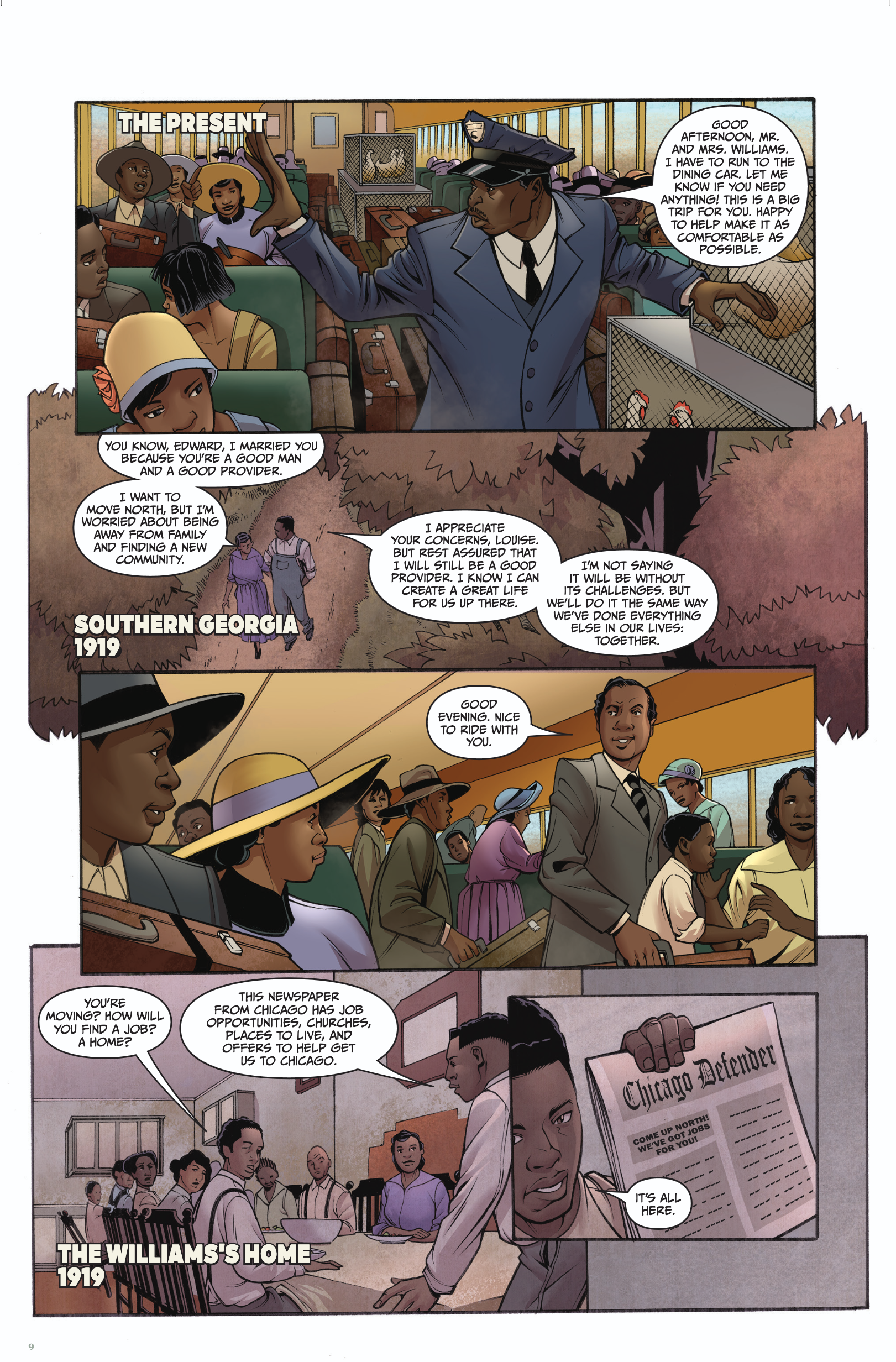
The page opens with Edward and Louise on a crowded train with many other Black passengers migrating North. We can see that for many Black Southerners, moving North was an act of resistance in itself. There is a real sense of community aboard the train, as the train worker offers to help Edward and Louise with anything they might need, and another family greets them in panel 3. There is also a strong connection between Edward and Louise themselves, shown in panel 2. This illustrates the resilience and strength migrants were able to find in each other on both a personal level and a larger community level. Panel 4 shows Edward and Louise with their friends and family, who are concerned that Edward and Louise will not be able to find new jobs or homes, and Edward assures them that the Chicago Defender has all the information they need. This reflects the theme that despite being a part of the same country, for many migrants in the First Great Migration, going North was much akin to moving to a new country might be with different social and economic structures. Edward and Louise’s loved ones are rightfully concerned, but Edward shows that the Chicago Defender has created and fed into a robust community network that they can tap into and contribute to. Community connections were absolutely vital for the First Great Migration.
Also an important theme in this page is the sense of hope that Edward and Louise feel as they begin their migration, reflected in the coloring and paneling. While the panels in the past are colored with duller colors, the ones in the present on the train are vibrant and hopeful, and the alternating pattern of present-past-present-past helps to emphasize that difference. Additionally, the panels in the present are drawn overlapped onto the panels from the past—they appear to be physically layered the same way they are temporally layered, and that both helps the reader not to get confused but also represents Edward and Louise’s desire to move forward in their lives.
Why Social Studies Comics Are a Powerful Way to Teach History
Kate Polak’s book, Ethics in the Gutter, speaks about historiometagraphic fiction, which “is meant to encapsulate works that deal with real-world events in fictional ways so as to comment on the way in which we shape narratives, receive them, and reframe them.” Two vital concepts to think about when analyzing historiometagraphic fiction like Edward and Louise's Journey are point of view as entry and comics as avenues to ask ethical questions.
In contrast to traditional prose, where students learn to identify the difference between first, second, and third person, comics have a unique ability to highlight different points of view in different panels based on camera angle and choice of subject. On this page, what stands out about the choice of subject is the aforementioned alternating between past and present. As discussed, the visual distinction in color and panel layout helps readers not to get lost and to understand the symbolism of what Edward and Louise’s migration means to them, but the alternating pattern of past and present also works because of how juxtaposition works in comics. Unlike in prose, comics are capable of communicating impactful juxtaposition much faster and more holistically because it’s a visual medium. Readers immediately get a “feeling” of two different times on this page because of the visual juxtaposition between the past and present panels, even if they haven’t yet processed what exact art techniques are making them feel that way. Because the visual representations of an event can often be more striking to viewers than simply reading about an event, meaning that any ethical questions posed by the comic can be more impactful.
“The term historio-metagraphics is meant to encapsulate works that deal with real-world events in fictional ways so as to comment on the way in which we shape narratives, receive them, and reframe them.” Kate Polak, Ethics in the Gutter: Empathy and Historical Fiction in Comics (Studies in Comics and Cartoons)
In Conclusion
Comic books can bring history to life in the classroom in ways that traditional textbooks and curriculums cannot, providing deeper opportunities for students to connect with the events and people of the past and take lessons from them that they can use to impact their present. Order copies of Edward and Louise's Journey for your classroom, sign up for our professional development webinars, and shop more of our inclusive catalog.
To hear all our latest updates, including new books, blog posts, and professional development opportunities, join our mailing list.
